
Newspapers Do the Hard Work, Digital Media Makes the Money: Is This the Right System?
Someone else does the reporting, someone else makes the money. But who takes responsibility?
The history of journalism in India is not just the history of publishing news. It is also the story of building an entire information network across villages, towns and cities. For decades, media organisations have invested in this system, appointed local reporters and built networks to collect information from the ground. Journalists gather facts, verify them through editorial checks and then bring the news to readers.
Indian print media may have its own shortcomings, but compared to media in many parts of the world, major Indian newspapers still appear relatively restrained and institutionally responsible. Behind every published story, there is a reporter, an editor and an entire editorial team that shares responsibility for what gets published.
However, the digital revolution has created a new challenge for this established system.
Today, news about an incident often appears first on Facebook, YouTube, Instagram and other social media platforms rather than on the website of the newspaper that originally reported it.
The problem is not the existence of these platforms. The real concern is the business model and information culture in which speed, sensationalism and the ability to go viral sometimes become more important than the accuracy of the news.
An incident takes place, and within minutes, people start analysing and discussing every possible angle. Dozens of videos, live shows, reactions and speculations begin appearing around the same story. Conclusions are drawn even before investigations are completed, and the public court delivers its verdict even before the actual court reaches one.
This is where the danger of media trials and social media trials begins.
The coverage of the Aarushi Talwar murder case is an important example in this debate. Reporting on serious crimes is both a right and a responsibility of the media. However, continuously putting an individual or an entire family under public suspicion through allegations and speculation can go far beyond responsible journalism.
The Vijay Mallya case offers another perspective on this issue. Investigations into a businessperson over bank liabilities, financial irregularities or criminal allegations are serious matters and must be reported. However, the difference between an allegation and a crime proven by a court of law must always be maintained in journalism.
Even today, we see numerous cases on television and social media where, as soon as allegations emerge against an individual, company or organisation, an entire narrative is created without properly verifying the facts. The focus shifts from reporting the news to building a particular perception.
The Real Issue Is Not Social Media, but Its Business Model
We must acknowledge that social media has made information more democratic. An ordinary citizen can now reach millions of people with their views. A journalist from a small town can reach a national audience. This is certainly a positive development for democracy.
However, major digital platforms such as Facebook, YouTube, Instagram and Google are primarily not journalism organisations. They are part of a massive global economy built around information distribution and digital advertising.
This creates a significant imbalance.
An Indian newspaper employs journalists to gather news. It appoints reporters at district and local levels. It maintains offices and spends money on travel, reporting, editing, printing and distribution.
Eventually, that same news reaches the digital world.
A social media platform then distributes the news to millions of people through its algorithms. Videos are created, reactions are generated, advertisements are displayed and user engagement increases.
The important question is: Who is paying the cost of original journalism, and who is receiving the larger share of the digital business generated from that information?
This is not just a question about the future of Indian print media. It is also a question of India’s information sovereignty.
Foreign Platforms, Indian Information
India is the world’s largest democracy and one of the biggest digital markets. The information, incidents, news and public reactions generated here are extremely valuable to these global platforms.
Therefore, the government should seriously consider establishing a system of fair attribution, licensing and revenue sharing for large digital platforms that commercially use original news content produced by Indian journalism organisations.
We can compare this, to some extent, with the mobile telecommunications industry, where companies pay for using the networks or infrastructure of other operators.
However, we need to be careful here as well.
The government should not introduce legislation that gives a newspaper ownership rights over ordinary facts. The facts surrounding an incident cannot become the private property of one media organisation.
The rights should apply to original reporting and its creative presentation, not to publicly available facts.
India Must Protect the Strength of Its Journalism System
When an Indian newspaper has maintained a network of reporters in a district for decades, that network represents much more than printing machines and paper. It reflects decades of investment, institutional experience, professional reputation and credibility.
Digital platforms do not need to build such an infrastructure themselves. They receive ready-made news, and their algorithms decide who should see it and how widely it should be distributed.
Therefore, it would be more appropriate to treat digital platforms as distribution channels rather than replacements for journalism organisations.
India needs a policy that encourages digital innovation without destroying the economic foundation of traditional journalism.
Accountability Is the Most Important Issue
Ultimately, the question is not whether news is published in a newspaper or presented on YouTube.
The real questions are:
- Who gathered the news?
- Who verified the information?
- Who edited and approved the story?
- And who will take responsibility if the information turns out to be wrong?
One incorrect report by a journalist can damage an individual’s reputation, family and business. But when the same misinformation enters the social media algorithm, it can reach millions of people within a few hours.
Therefore, a medium that has the power to reach millions must also carry responsibility in proportion to its reach.
Think of print media as a kitchen where ingredients are collected, cleaned, prepared and cooked before the food is served.
Social media, on the other hand, sometimes starts behaving like a fast-food counter, where the biggest priority becomes who serves the plate first.
There is nothing wrong with fast food. The problem begins when speed of serving becomes more important than taste, quality and health.
The same distinction must be understood in journalism.
Being the first to deliver the news may be an achievement, but delivering accurate news is a responsibility.
India needs a digital ecosystem where technology makes news faster without compromising its accuracy and accountability.
After all, an algorithm can make news go viral, but only responsible journalism can build trust.
Today, the need is not to stop the digital world but to make it more responsible.
The networks and credibility that Indian newspapers have built over decades cannot simply be handed over to a race for viral content that lasts a few seconds. An algorithm may decide how many people see a particular story, but it cannot be given the authority to decide what the truth is or who is guilty.
India needs a media ecosystem where there is speed in news delivery and strength in technology, but the credibility and accountability of journalism remain above everything else.
Ultimately, news is not just content that can be sold. It is a responsibility entrusted to the media by society. And this responsibility cannot become the monopoly of any foreign algorithm.
Print media must also adapt to the digital age. However, its decades-old reporting infrastructure should not be allowed to become a free content source for global digital companies.
There is another worrying trend in television journalism.
What once started with the term Breaking News has now moved to expressions like Super Breaking, Ultra Fast, Super Fast, First on Our Channel and Only on Our Channel.
These phrases are increasingly being used to create sensationalism, making it appear as though news itself is being sold like a commercial product.
News is not just content.
Behind every news story, there is a journalist’s hard work, an organisation’s investment and a responsibility towards society.
And in a democracy, these should be the most important questions:
Did the organisation that actually produced the news receive its fair value?
And did the platform that distributed that news to millions also accept responsibility for it?
Rotarian Sunil Dutt Goyal
Director General, Imperial Chamber of Commerce and Industry
Ex. Vice President, Jaipur Stock Exchange Limited
Jaipur, Rajasthan
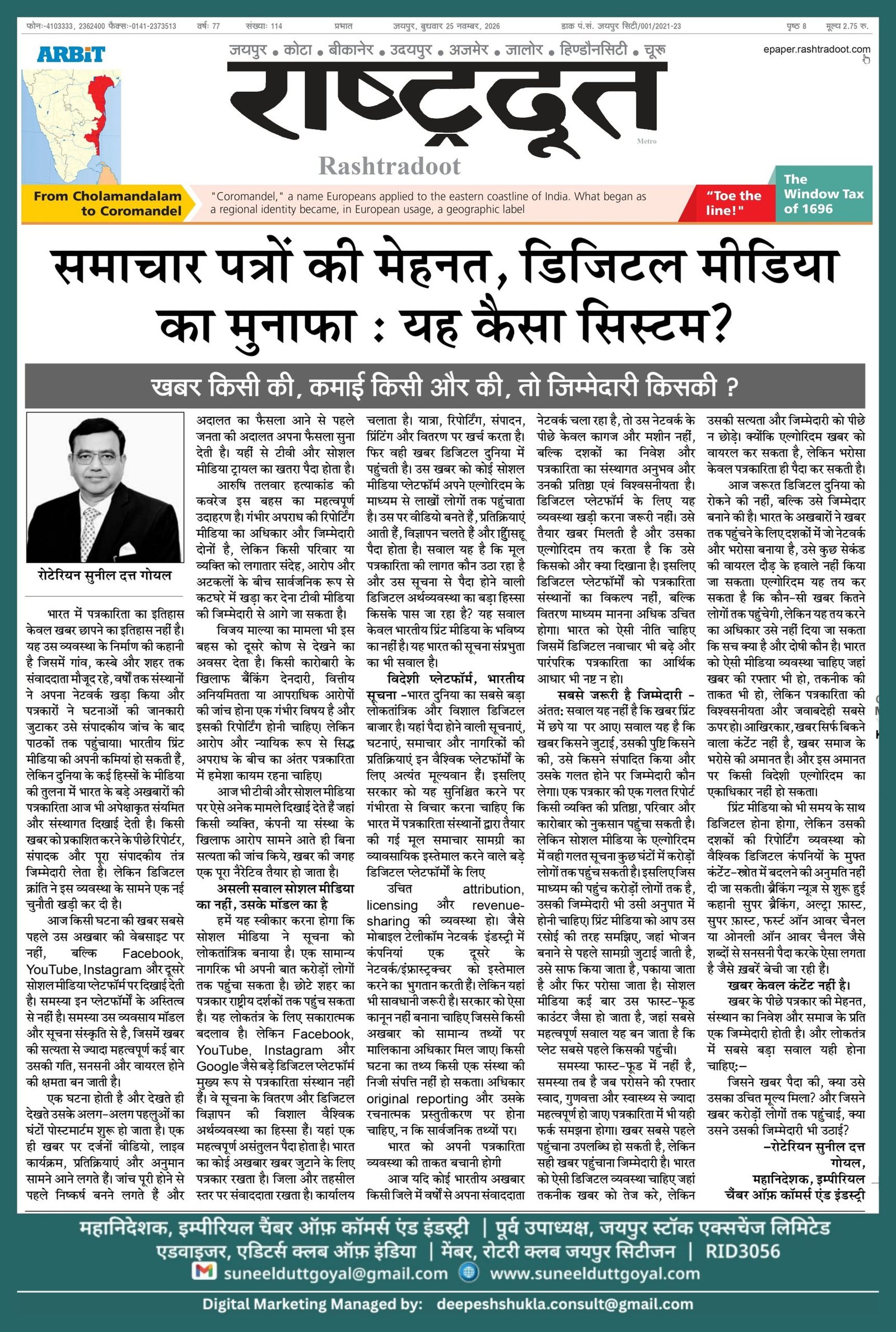
समाचार पत्रों की मेहनत, डिजिटल मीडिया का मुनाफा: यह कैसा सिस्टम ?
खबर किसी की, कमाई किसी और की , तो जिम्मेदारी किसकी ?
भारत में पत्रकारिता का इतिहास केवल खबर छापने का इतिहास नहीं है। यह उस व्यवस्था के निर्माण की कहानी है जिसमें गांव, कस्बे और शहर तक संवाददाता मौजूद रहे, वर्षों तक संस्थानों ने अपना नेटवर्क खड़ा किया और पत्रकारों ने घटनाओं की जानकारी जुटाकर उसे संपादकीय जांच के बाद पाठकों तक पहुंचाया।
भारतीय प्रिंट मीडिया की अपनी कमियां हो सकती हैं, लेकिन दुनिया के कई हिस्सों के मीडिया की तुलना में भारत के बड़े अखबारों की पत्रकारिता आज भी अपेक्षाकृत संयमित और संस्थागत दिखाई देती है। किसी खबर को प्रकाशित करने के पीछे रिपोर्टर, संपादक और पूरा संपादकीय तंत्र जिम्मेदारी लेता है।
लेकिन डिजिटल क्रांति ने इस व्यवस्था के सामने एक नई चुनौती खड़ी कर दी है।
आज किसी घटना की खबर सबसे पहले उस अखबार की वेबसाइट पर नहीं, बल्कि Facebook, YouTube, Instagram और दूसरे सोशल मीडिया प्लेटफॉर्म पर दिखाई देती है। समस्या इन प्लेटफॉर्मों के अस्तित्व से नहीं है। समस्या उस व्यवसाय मॉडल और सूचना संस्कृति से है, जिसमें खबर की सत्यता से ज्यादा महत्वपूर्ण कई बार उसकी गति, सनसनी और वायरल होने की क्षमता बन जाती है।
एक घटना होती है और देखते ही देखते उसके अलग-अलग पहलुओं का घंटों पोस्टमार्टम शुरू हो जाता है। एक ही खबर पर दर्जनों वीडियो, लाइव कार्यक्रम, प्रतिक्रियाएं और अनुमान सामने आने लगते हैं। जांच पूरी होने से पहले निष्कर्ष बनने लगते हैं और अदालत का फैसला आने से पहले जनता की अदालत अपना फैसला सुना देती है।
यहीं से टीवी और सोशल मीडिया ट्रायल का खतरा पैदा होता है।
आरुषि तलवार हत्याकांड की कवरेज इस बहस का महत्वपूर्ण उदाहरण है। गंभीर अपराध की रिपोर्टिंग मीडिया का अधिकार और जिम्मेदारी दोनों है, लेकिन किसी परिवार या व्यक्ति को लगातार संदेह, आरोप और अटकलों के बीच सार्वजनिक रूप से कटघरे में खड़ा कर देना टीवी मीडिया की जिम्मेदारी से आगे जा सकता है।
विजय माल्या का मामला भी इस बहस को दूसरे कोण से देखने का अवसर देता है। किसी कारोबारी के खिलाफ बैंकिंग देनदारी, वित्तीय अनियमितता या आपराधिक आरोपों की जांच होना एक गंभीर विषय है और इसकी रिपोर्टिंग होनी चाहिए। लेकिन आरोप और न्यायिक रूप से सिद्ध अपराध के बीच का अंतर पत्रकारिता में हमेशा कायम रहना चाहिए।
आज भी टीवी और सोशल मीडिया पर ऐसे अनेक मामले दिखाई देते हैं जहां किसी व्यक्ति, कंपनी या संस्था के खिलाफ आरोप सामने आते ही बिना सत्यता की जांच किये, खबर की जगह एक पूरा नैरेटिव तैयार हो जाता है।
असली सवाल सोशल मीडिया का नहीं, उसके मॉडल का है
हमें यह स्वीकार करना होगा कि सोशल मीडिया ने सूचना को लोकतांत्रिक बनाया है। एक सामान्य नागरिक भी अपनी बात करोड़ों लोगों तक पहुंचा सकता है। छोटे शहर का पत्रकार राष्ट्रीय दर्शकों तक पहुंच सकता है। यह लोकतंत्र के लिए सकारात्मक बदलाव है।
लेकिन Facebook, YouTube, Instagram और Google जैसे बड़े डिजिटल प्लेटफॉर्म मुख्य रूप से पत्रकारिता संस्थान नहीं हैं। वे सूचना के वितरण और डिजिटल विज्ञापन की विशाल वैश्विक अर्थव्यवस्था का हिस्सा हैं।
यहां एक महत्वपूर्ण असंतुलन पैदा होता है।
भारत का कोई अखबार खबर जुटाने के लिए पत्रकार रखता है। जिला और तहसील स्तर पर संवाददाता रखता है। कार्यालय चलाता है। यात्रा, रिपोर्टिंग, संपादन, प्रिंटिंग और वितरण पर खर्च करता है।
फिर वही खबर डिजिटल दुनिया में पहुंचती है।
उस खबर को कोई सोशल मीडिया प्लेटफॉर्म अपने एल्गोरिदम के माध्यम से लाखों लोगों तक पहुंचाता है। उस पर वीडियो बनते हैं, प्रतिक्रियाएं आती हैं, विज्ञापन चलते हैं और engagement पैदा होता है।
सवाल यह है कि मूल पत्रकारिता की लागत कौन उठा रहा है और उस सूचना से पैदा होने वाली डिजिटल अर्थव्यवस्था का बड़ा हिस्सा किसके पास जा रहा है?
यह सवाल केवल भारतीय प्रिंट मीडिया के भविष्य का नहीं है। यह भारत की सूचना संप्रभुता का भी सवाल है।
विदेशी प्लेटफॉर्म, भारतीय सूचना
भारत दुनिया का सबसे बड़ा लोकतांत्रिक और विशाल डिजिटल बाजार है। यहां पैदा होने वाली सूचनाएं, घटनाएं, समाचार और नागरिकों की प्रतिक्रियाएं इन वैश्विक प्लेटफॉर्मों के लिए अत्यंत मूल्यवान हैं।
इसलिए सरकार को यह सुनिश्चित करने पर गंभीरता से विचार करना चाहिए कि भारत में पत्रकारिता संस्थानों द्वारा तैयार की गई मूल समाचार सामग्री का व्यावसायिक इस्तेमाल करने वाले बड़े डिजिटल प्लेटफॉर्मों के लिए उचित attribution, licensing और revenue-sharing की व्यवस्था हो। जैसे मोबाइल टेलीकॉम नेटवर्क इंडस्ट्री में कंपनियां एक दूसरे के नेटवर्क/इंफ्रास्ट्रक्चर को इस्तेमाल करने का भुगतान करती हैं।
लेकिन यहां भी सावधानी जरूरी है।
सरकार को ऐसा कानून नहीं बनाना चाहिए जिससे किसी अखबार को सामान्य तथ्यों पर मालिकाना अधिकार मिल जाए। किसी घटना का तथ्य किसी एक संस्था की निजी संपत्ति नहीं हो सकता।
अधिकार original reporting और उसके रचनात्मक प्रस्तुतीकरण पर होना चाहिए, न कि सार्वजनिक तथ्यों पर।
भारत को अपनी पत्रकारिता व्यवस्था की ताकत बचानी होगी
आज यदि कोई भारतीय अखबार किसी जिले में वर्षों से अपना संवाददाता नेटवर्क चला रहा है, तो उस नेटवर्क के पीछे केवल कागज और मशीन नहीं, बल्कि दशकों का निवेश और पत्रकारिता का संस्थागत अनुभव और उनकी प्रतिष्ठा एवं विश्वसनीयता है।
डिजिटल प्लेटफॉर्म के लिए यह व्यवस्था खड़ी करना जरूरी नहीं। उसे तैयार खबर मिलती है और उसका एल्गोरिदम तय करता है कि उसे किसको और क्या दिखाना है।
इसलिए डिजिटल प्लेटफॉर्मों को पत्रकारिता संस्थानों का विकल्प नहीं, बल्कि वितरण माध्यम मानना अधिक उचित होगा।
भारत को ऐसी नीति चाहिए जिसमें डिजिटल नवाचार भी बढ़े और पारंपरिक पत्रकारिता का आर्थिक आधार भी नष्ट न हो।
सबसे जरूरी है जिम्मेदारी
अंततः सवाल यह नहीं है कि खबर प्रिंट में छपे या YouTube पर आए।
सवाल यह है कि खबर किसने जुटाई, उसकी पुष्टि किसने की, उसे किसने संपादित किया और उसके गलत होने पर जिम्मेदारी कौन लेगा।
एक पत्रकार की एक गलत रिपोर्ट किसी व्यक्ति की प्रतिष्ठा, परिवार और कारोबार को नुकसान पहुंचा सकती है। लेकिन सोशल मीडिया के एल्गोरिदम में वही गलत सूचना कुछ घंटों में करोड़ों लोगों तक पहुंच सकती है।
इसलिए जिस माध्यम की पहुंच करोड़ों लोगों तक है, उसकी जिम्मेदारी भी उसी अनुपात में होनी चाहिए।
प्रिंट मीडिया को आप उस रसोई की तरह समझिए, जहां भोजन बनाने से पहले सामग्री जुटाई जाती है, उसे साफ किया जाता है, पकाया जाता है और फिर परोसा जाता है। सोशल मीडिया कई बार उस फास्ट-फूड काउंटर जैसा हो जाता है, जहां सबसे महत्वपूर्ण सवाल यह बन जाता है कि प्लेट सबसे पहले किसकी पहुंची।
समस्या फास्ट-फूड में नहीं है, समस्या तब है जब परोसने की रफ्तार स्वाद, गुणवत्ता और स्वास्थ्य से ज्यादा महत्वपूर्ण हो जाए। पत्रकारिता में भी यही फर्क समझना होगा। खबर सबसे पहले पहुंचाना उपलब्धि हो सकती है, लेकिन सही खबर पहुंचाना जिम्मेदारी है। भारत को ऐसी डिजिटल व्यवस्था चाहिए जहां तकनीक खबर को तेज करे, लेकिन उसकी सत्यता और जिम्मेदारी को पीछे न छोड़े। क्योंकि एल्गोरिदम खबर को वायरल कर सकता है, लेकिन भरोसा केवल पत्रकारिता ही पैदा कर सकती है।
आज जरूरत डिजिटल दुनिया को रोकने की नहीं, बल्कि उसे जिम्मेदार बनाने की है। भारत के अखबारों ने खबर तक पहुंचने के लिए दशकों में जो नेटवर्क और भरोसा बनाया है, उसे कुछ सेकंड की वायरल दौड़ के हवाले नहीं किया जा सकता। एल्गोरिदम यह तय कर सकता है कि कौन-सी खबर कितने लोगों तक पहुंचेगी, लेकिन यह तय करने का अधिकार उसे नहीं दिया जा सकता कि सच क्या है और दोषी कौन है। भारत को ऐसी मीडिया व्यवस्था चाहिए जहां खबर की रफ्तार भी हो, तकनीक की ताकत भी हो, लेकिन पत्रकारिता की विश्वसनीयता और जवाबदेही सबसे ऊपर हो। आखिरकार, खबर सिर्फ बिकने वाला कंटेंट नहीं है, खबर समाज के भरोसे की अमानत है। और इस अमानत पर किसी विदेशी एल्गोरिदम का एकाधिकार नहीं हो सकता।
प्रिंट मीडिया को भी समय के साथ डिजिटल होना होगा, लेकिन उसकी दशकों की रिपोर्टिंग व्यवस्था को वैश्विक डिजिटल कंपनियों के मुफ्त कंटेंट-स्रोत में बदलने की अनुमति नहीं दी जा सकती।
ब्रैकिंग न्यूज़ से शुरू हुई कहानी सुपर ब्रैकिंग, अल्ट्रा फ़ास्ट, सुपर फ़ास्ट, फर्स्ट ऑन आवर चैनल या ओनली ऑन आवर चैनल जैसे शब्दों से सनसनी पैदा करके ऐसा लगता है जैसे ख़बरें बेची जा रही हैं।
खबर केवल कंटेंट नहीं है।
खबर के पीछे पत्रकार की मेहनत, संस्थान का निवेश और समाज के प्रति एक जिम्मेदारी होती है।
और लोकतंत्र में सबसे बड़ा सवाल यही होना चाहिए:
जिसने खबर पैदा की, क्या उसे उसका उचित मूल्य मिला?
और जिसने खबर करोड़ों लोगों तक पहुंचाई, क्या उसने उसकी जिम्मेदारी भी उठाई?
रोटेरियन सुनील दत्त गोयल
महानिदेशक, इम्पीरियल चैंबर ऑफ़ कॉमर्स एंड इंडस्ट्री
पूर्व उपाध्यक्ष, जयपुर स्टॉक एक्सचेंज लिमिटेड
जयपुर, राजस्थान