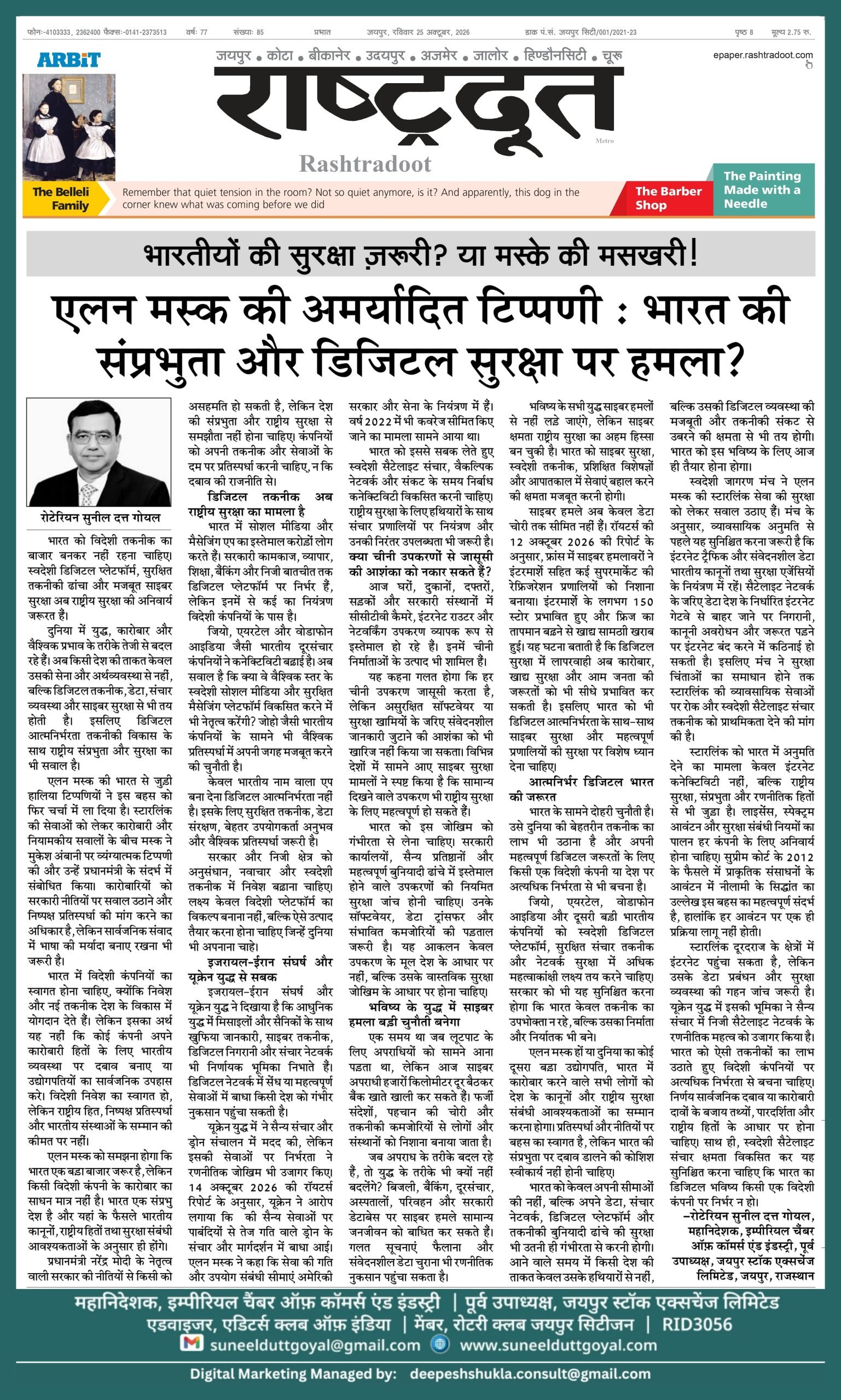

Elon Musk’s Inappropriate Remarks: An Attack on India’s Sovereignty and Digital Security?
Do We Care About the Safety of Indians, or Musk’s Mockery?
Elon Musk’s Inappropriate Remarks: An Attack on India’s Sovereignty and Digital Security?
India must not remain just a market for foreign technology. Homegrown digital platforms, secure technological infrastructure, and strong cybersecurity are now essential for national security.
The way wars are fought, business is conducted, and global influence is exercised is changing rapidly. Today, a country’s strength is not determined only by its military and economy. Digital technology, data, communication systems, and cybersecurity have also become major factors. That is why digital self-reliance is not just about technological development. It is also about national sovereignty and security.
Elon Musk’s recent comments about India have brought this debate back into the spotlight. Amid business and regulatory questions surrounding Starlink’s services, Musk made a sarcastic remark about Mukesh Ambani, referring to him in the context of the Prime Minister. Business leaders have every right to question government policies and demand fair competition. However, maintaining a reasonable and respectful tone in public discussions is equally important.
India should welcome foreign companies because investment and new technology contribute to the country’s development. But that does not mean any company should be allowed to pressure the Indian system to protect its business interests or publicly mock Indian industrialists.
Foreign investment is welcome, but not at the cost of national interests, fair competition, or respect for Indian institutions.
Elon Musk needs to understand that India may be a huge market, but it is not merely a place for foreign companies to do business on their own terms. India is a sovereign nation, and decisions here must be made according to Indian laws, national interests, and security requirements.
People may disagree with the policies of the government led by Prime Minister Narendra Modi. However, national sovereignty and security must never be compromised. Companies should compete on the strength of their technology and services, not through pressure tactics.
Digital Technology Has Become a National Security Issue
Millions of Indians use social media and messaging apps every day. Government operations, businesses, education, banking, and even private conversations depend heavily on digital platforms. Yet, many of these platforms are controlled by foreign companies.
Indian telecom companies such as Jio, Airtel, and Vodafone Idea have expanded connectivity across the country. But the question is: Will they also take the lead in developing world-class Indian social media and secure messaging platforms?
Indian companies such as Zoho also face the challenge of strengthening their position in the global technology market.
Simply launching an app with an Indian name does not mean achieving digital self-reliance. Real self-reliance requires secure technology, strong data protection, a better user experience, and the ability to compete globally.
The government and private sector must increase investment in research, innovation, and homegrown technology. The goal should not be limited to creating alternatives to foreign platforms. India should develop products that people around the world would also want to use.
Lessons from the Israel-Iran Conflict and the Ukraine War
The Israel-Iran conflict and the war in Ukraine have shown that modern warfare depends not only on missiles and soldiers but also on intelligence, cyber technology, digital surveillance, and communication networks.
A breach in digital networks or a disruption of essential services can cause serious damage to a country.
During the Ukraine war, Starlink helped support military communications and drone operations. However, dependence on the service also highlighted strategic risks.
According to a Reuters report dated October 14, 2026, Ukraine alleged that restrictions on Starlink’s military services disrupted communications and guidance for high-speed drones. Elon Musk said that restrictions on service speed and usage were under the control of the US government and military. A similar issue involving limitations on Starlink coverage had also emerged in 2022.
India must learn from these experiences and develop its own satellite communication systems, alternative networks, and reliable connectivity that can continue operating during a crisis.
National security requires not only advanced weapons but also control over communication systems and the ability to keep them available when they are needed most.
Can We Ignore the Risk of Spying Through Chinese Equipment?
CCTV cameras, internet routers, and networking equipment are now widely used in homes, shops, offices, streets, and government institutions. Products made by Chinese manufacturers are also part of this infrastructure.
It would be wrong to claim that every Chinese device is used for spying. However, we cannot ignore the possibility that insecure software or security vulnerabilities could be exploited to collect sensitive information.
Cybersecurity incidents reported in different countries have made one thing clear: Even devices that appear ordinary can have serious implications for national security.
India must take these risks seriously.
Equipment used in government offices, military installations, and critical infrastructure should undergo regular security assessments. Its software, data transfers, and potential vulnerabilities must be carefully examined.
Such assessments should not be based solely on the country where a product was manufactured. They should be based on its actual security risks, vulnerabilities, and potential impact.
Cyberattacks Will Be a Major Challenge in Future Wars
There was a time when criminals had to physically approach their victims to rob them. Today, cybercriminals can sit thousands of kilometres away and empty bank accounts.
People and institutions are targeted through fraudulent messages, identity theft, and technical vulnerabilities.
If methods of committing crimes are changing, why would methods of warfare remain the same?
Cyberattacks on electricity networks, banking systems, telecommunications, hospitals, transport systems, and government databases can disrupt everyday life. Spreading misinformation and stealing sensitive data can also cause serious strategic damage.
Not every future war will be fought through cyberattacks, but cyber capabilities have already become a critical part of national security.
India must strengthen its cybersecurity systems, develop indigenous technology, train skilled professionals, and improve its ability to restore essential services during emergencies.
Cyberattacks are no longer limited to stealing data.
According to a Reuters report dated October 12, 2026, cyberattackers in France targeted refrigeration systems at several supermarkets, including Intermarché. Around 150 Intermarché stores were affected, and rising refrigerator temperatures led to food spoilage.
This incident shows that negligence in digital security can directly affect businesses, food safety, and the daily needs of ordinary people.
India must therefore focus not only on digital self-reliance but also on cybersecurity and the protection of critical systems.
Why India Needs a Self-Reliant Digital Ecosystem
India faces a dual challenge. It must benefit from the best technology available globally while avoiding excessive dependence on any single foreign company or country for its critical digital needs.
Jio, Airtel, Vodafone Idea, and other major Indian companies should set more ambitious goals for developing homegrown digital platforms, secure communication technologies, and network security solutions.
The government must also ensure that India does not remain merely a consumer of technology. It should become a creator and exporter of technology as well.
Whether it is Elon Musk or any other global business leader, everyone operating in India must respect the country’s laws and national security requirements.
Healthy competition and debate over government policies are welcome. However, attempts to put pressure on India over its sovereignty should not be acceptable.
India must protect not only its physical borders but also its data, communication networks, digital platforms, and technological infrastructure with equal seriousness.
In the coming years, a country’s strength will be measured not only by its weapons but also by the resilience of its digital systems and its ability to recover from technological crises.
India must start preparing for this future today.
Swadeshi Jagran Manch Raises Questions About Starlink’s Security
Swadeshi Jagran Manch has raised concerns about the security of Elon Musk’s Starlink service.
According to the organisation, before commercial permission is granted, it is essential to ensure that internet traffic and sensitive data remain subject to Indian laws and the oversight of Indian security agencies.
If data transmitted through satellite networks bypasses India’s designated internet gateways, it could become more difficult to monitor traffic, carry out lawful interception, and suspend internet services when required.
The organisation has therefore called for Starlink’s commercial services to be withheld until security concerns are addressed. It has also urged the government to prioritise indigenous satellite communication technology.
The question of allowing Starlink to operate in India is not simply about improving internet connectivity. It is also linked to national security, sovereignty, and strategic interests.
Every company must comply with applicable licensing requirements, spectrum allocation rules, and security regulations.
The Supreme Court’s 2012 judgment, which discussed the principle of auctions in the allocation of natural resources, is an important reference in this debate. However, the same allocation procedure does not necessarily apply to every type of resource or service.
Starlink could improve internet access in remote areas, but its data management practices and security arrangements require thorough scrutiny.
Its role in the Ukraine war has demonstrated the strategic importance of privately operated satellite networks in military communications.
India should benefit from such technologies while avoiding excessive dependence on foreign companies.
Decisions must be based on facts, transparency, and national interests, rather than public pressure or business claims.
At the same time, India must develop its own satellite communication capabilities to ensure that the country’s digital future does not depend on a single foreign company.
Rotarian Suneel Dutt Goyal
Director General, Imperial Chamber of Commerce and Industry
Ex. Vice President, Jaipur Stock Exchange Limited
Jaipur, Rajasthan
भारतीयों की सुरक्षा ज़रूरी ? या मस्के की मसखरी !
एलन मस्क की अमर्यादित टिप्पणी : भारत की संप्रभुता और डिजिटल सुरक्षा पर हमला ?
भारत को विदेशी तकनीक का बाजार बनकर नहीं रहना चाहिए। स्वदेशी डिजिटल प्लेटफॉर्म, सुरक्षित तकनीकी ढांचा और मजबूत साइबर सुरक्षा अब राष्ट्रीय सुरक्षा की अनिवार्य जरूरत हैं।
दुनिया में युद्ध, कारोबार और वैश्विक प्रभाव के तरीके तेजी से बदल रहे हैं। अब किसी देश की ताकत केवल उसकी सेना और अर्थव्यवस्था से नहीं, बल्कि डिजिटल तकनीक, डेटा, संचार व्यवस्था और साइबर सुरक्षा से भी तय होती है। इसलिए डिजिटल आत्मनिर्भरता तकनीकी विकास के साथ राष्ट्रीय संप्रभुता और सुरक्षा का भी सवाल है।
एलन मस्क की भारत से जुड़ी हालिया टिप्पणियों ने इस बहस को फिर चर्चा में ला दिया है। स्टारलिंक की सेवाओं को लेकर कारोबारी और नियामकीय सवालों के बीच मस्क ने मुकेश अंबानी पर व्यंग्यात्मक टिप्पणी की और उन्हें प्रधानमंत्री के संदर्भ में संबोधित किया। कारोबारियों को सरकारी नीतियों पर सवाल उठाने और निष्पक्ष प्रतिस्पर्धा की मांग करने का अधिकार है, लेकिन सार्वजनिक संवाद में भाषा की मर्यादा बनाए रखना भी जरूरी है।
भारत में विदेशी कंपनियों का स्वागत होना चाहिए, क्योंकि निवेश और नई तकनीक देश के विकास में योगदान देते हैं। लेकिन इसका अर्थ यह नहीं कि कोई कंपनी अपने कारोबारी हितों के लिए भारतीय व्यवस्था पर दबाव बनाए या उद्योगपतियों का सार्वजनिक उपहास करे। विदेशी निवेश का स्वागत हो, लेकिन राष्ट्रीय हित, निष्पक्ष प्रतिस्पर्धा और भारतीय संस्थाओं के सम्मान की कीमत पर नहीं।
एलन मस्क को समझना होगा कि भारत एक बड़ा बाजार जरूर है, लेकिन किसी विदेशी कंपनी के कारोबार का साधन मात्र नहीं है। भारत एक संप्रभु देश है और यहां के फैसले भारतीय कानूनों, राष्ट्रीय हितों तथा सुरक्षा संबंधी आवश्यकताओं के अनुसार ही होंगे।
प्रधानमंत्री नरेंद्र मोदी के नेतृत्व वाली सरकार की नीतियों से किसी को असहमति हो सकती है, लेकिन देश की संप्रभुता और राष्ट्रीय सुरक्षा से समझौता नहीं होना चाहिए। कंपनियों को अपनी तकनीक और सेवाओं के दम पर प्रतिस्पर्धा करनी चाहिए, न कि दबाव की राजनीति से।
डिजिटल तकनीक अब राष्ट्रीय सुरक्षा का मामला है
भारत में सोशल मीडिया और मैसेजिंग एप का इस्तेमाल करोड़ों लोग करते हैं। सरकारी कामकाज, व्यापार, शिक्षा, बैंकिंग और निजी बातचीत तक डिजिटल प्लेटफॉर्म पर निर्भर हैं, लेकिन इनमें से कई का नियंत्रण विदेशी कंपनियों के पास है।
जियो, एयरटेल और वोडाफोन आइडिया जैसी भारतीय दूरसंचार कंपनियों ने कनेक्टिविटी बढ़ाई है। अब सवाल है कि क्या वे वैश्विक स्तर के स्वदेशी सोशल मीडिया और सुरक्षित मैसेजिंग प्लेटफॉर्म विकसित करने में भी नेतृत्व करेंगी? जोहो जैसी भारतीय कंपनियों के सामने भी वैश्विक प्रतिस्पर्धा में अपनी जगह मजबूत करने की चुनौती है।
केवल भारतीय नाम वाला एप बना देना डिजिटल आत्मनिर्भरता नहीं है। इसके लिए सुरक्षित तकनीक, डेटा संरक्षण, बेहतर उपयोगकर्ता अनुभव और वैश्विक प्रतिस्पर्धा जरूरी है।
सरकार और निजी क्षेत्र को अनुसंधान, नवाचार और स्वदेशी तकनीक में निवेश बढ़ाना चाहिए। लक्ष्य केवल विदेशी प्लेटफॉर्म का विकल्प बनाना नहीं, बल्कि ऐसे उत्पाद तैयार करना होना चाहिए जिन्हें दुनिया भी अपनाना चाहे।
इजरायल-ईरान संघर्ष और यूक्रेन युद्ध से सबक
इजरायल-ईरान संघर्ष और यूक्रेन युद्ध ने दिखाया है कि आधुनिक युद्ध में मिसाइलों और सैनिकों के साथ खुफिया जानकारी, साइबर तकनीक, डिजिटल निगरानी और संचार नेटवर्क भी निर्णायक भूमिका निभाते हैं। डिजिटल नेटवर्क में सेंध या महत्वपूर्ण सेवाओं में बाधा किसी देश को गंभीर नुकसान पहुंचा सकती है।
यूक्रेन युद्ध में Starlink ने सैन्य संचार और ड्रोन संचालन में मदद की, लेकिन इसकी सेवाओं पर निर्भरता ने रणनीतिक जोखिम भी उजागर किए। 14 अक्टूबर 2026 की रॉयटर्स रिपोर्ट के अनुसार, यूक्रेन ने आरोप लगाया कि Starlink की सैन्य सेवाओं पर पाबंदियों से तेज गति वाले ड्रोन के संचार और मार्गदर्शन में बाधा आई। एलन मस्क ने कहा कि सेवा की गति और उपयोग संबंधी सीमाएं अमेरिकी सरकार और सेना के नियंत्रण में हैं। वर्ष 2022 में भी Starlink कवरेज सीमित किए जाने का मामला सामने आया था।
भारत को इससे सबक लेते हुए स्वदेशी सैटेलाइट संचार, वैकल्पिक नेटवर्क और संकट के समय निर्बाध कनेक्टिविटी विकसित करनी चाहिए। राष्ट्रीय सुरक्षा के लिए हथियारों के साथ संचार प्रणालियों पर नियंत्रण और उनकी निरंतर उपलब्धता भी जरूरी है।
क्या चीनी उपकरणों से जासूसी की आशंका को नकार सकते हैं?
आज घरों, दुकानों, दफ्तरों, सड़कों और सरकारी संस्थानों में सीसीटीवी कैमरे, इंटरनेट राउटर और नेटवर्किंग उपकरण व्यापक रूप से इस्तेमाल हो रहे हैं। इनमें चीनी निर्माताओं के उत्पाद भी शामिल हैं।
यह कहना गलत होगा कि हर चीनी उपकरण जासूसी करता है, लेकिन असुरक्षित सॉफ्टवेयर या सुरक्षा खामियों के जरिए संवेदनशील जानकारी जुटाने की आशंका को भी खारिज नहीं किया जा सकता। विभिन्न देशों में सामने आए साइबर सुरक्षा मामलों ने स्पष्ट किया है कि सामान्य दिखने वाले उपकरण भी राष्ट्रीय सुरक्षा के लिए महत्वपूर्ण हो सकते हैं।
भारत को इस जोखिम को गंभीरता से लेना चाहिए। सरकारी कार्यालयों, सैन्य प्रतिष्ठानों और महत्वपूर्ण बुनियादी ढांचे में इस्तेमाल होने वाले उपकरणों की नियमित सुरक्षा जांच होनी चाहिए। उनके सॉफ्टवेयर, डेटा ट्रांसफर और संभावित कमजोरियों की पड़ताल जरूरी है। यह आकलन केवल उपकरण के मूल देश के आधार पर नहीं, बल्कि उसके वास्तविक सुरक्षा जोखिम के आधार पर होना चाहिए।
भविष्य के युद्ध में साइबर हमला बड़ी चुनौती बनेगा
एक समय था जब लूटपाट के लिए अपराधियों को सामने आना पड़ता था, लेकिन आज साइबर अपराधी हजारों किलोमीटर दूर बैठकर बैंक खाते खाली कर सकते हैं। फर्जी संदेशों, पहचान की चोरी और तकनीकी कमजोरियों से लोगों और संस्थानों को निशाना बनाया जाता है।
जब अपराध के तरीके बदल रहे हैं, तो युद्ध के तरीके भी क्यों नहीं बदलेंगे? बिजली, बैंकिंग, दूरसंचार, अस्पतालों, परिवहन और सरकारी डेटाबेस पर साइबर हमले सामान्य जनजीवन को बाधित कर सकते हैं। गलत सूचनाएं फैलाना और संवेदनशील डेटा चुराना भी रणनीतिक नुकसान पहुंचा सकता है।
भविष्य के सभी युद्ध साइबर हमलों से नहीं लड़े जाएंगे, लेकिन साइबर क्षमता राष्ट्रीय सुरक्षा का अहम हिस्सा बन चुकी है। भारत को साइबर सुरक्षा, स्वदेशी तकनीक, प्रशिक्षित विशेषज्ञों और आपातकाल में सेवाएं बहाल करने की क्षमता मजबूत करनी होगी।
साइबर हमले अब केवल डेटा चोरी तक सीमित नहीं हैं। रॉयटर्स की 12 अक्टूबर 2026 की रिपोर्ट के अनुसार, फ्रांस में साइबर हमलावरों ने इंटरमार्शे सहित कई सुपरमार्केट की रेफ्रिजरेशन प्रणालियों को निशाना बनाया। इंटरमार्शे के लगभग 150 स्टोर प्रभावित हुए और फ्रिज का तापमान बढ़ने से खाद्य सामग्री खराब हुई। यह घटना बताती है कि डिजिटल सुरक्षा में लापरवाही अब कारोबार, खाद्य सुरक्षा और आम जनता की जरूरतों को भी सीधे प्रभावित कर सकती है। इसलिए भारत को भी डिजिटल आत्मनिर्भरता के साथ-साथ साइबर सुरक्षा और महत्वपूर्ण प्रणालियों की सुरक्षा पर विशेष ध्यान देना चाहिए।
आत्मनिर्भर डिजिटल भारत की जरूरत
भारत के सामने दोहरी चुनौती है। उसे दुनिया की बेहतरीन तकनीक का लाभ भी उठाना है और अपनी महत्वपूर्ण डिजिटल जरूरतों के लिए किसी एक विदेशी कंपनी या देश पर अत्यधिक निर्भरता से भी बचना है।
जियो, एयरटेल, वोडाफोन आइडिया और दूसरी बड़ी भारतीय कंपनियों को स्वदेशी डिजिटल प्लेटफॉर्म, सुरक्षित संचार तकनीक और नेटवर्क सुरक्षा में अधिक महत्वाकांक्षी लक्ष्य तय करने चाहिए। सरकार को भी यह सुनिश्चित करना होगा कि भारत केवल तकनीक का उपभोक्ता न रहे, बल्कि उसका निर्माता और निर्यातक भी बने।
एलन मस्क हों या दुनिया का कोई दूसरा बड़ा उद्योगपति, भारत में कारोबार करने वाले सभी लोगों को देश के कानूनों और राष्ट्रीय सुरक्षा संबंधी आवश्यकताओं का सम्मान करना होगा। प्रतिस्पर्धा और नीतियों पर बहस का स्वागत है, लेकिन भारत की संप्रभुता पर दबाव डालने की कोशिश स्वीकार्य नहीं होनी चाहिए।
भारत को केवल अपनी सीमाओं की नहीं, बल्कि अपने डेटा, संचार नेटवर्क, डिजिटल प्लेटफॉर्म और तकनीकी बुनियादी ढांचे की सुरक्षा भी उतनी ही गंभीरता से करनी होगी। आने वाले समय में किसी देश की ताकत केवल उसके हथियारों से नहीं, बल्कि उसकी डिजिटल व्यवस्था की मजबूती और तकनीकी संकट से उबरने की क्षमता से भी तय होगी। भारत को इस भविष्य के लिए आज ही तैयार होना होगा।
स्वदेशी जागरण मंच ने एलन मस्क की स्टारलिंक सेवा की सुरक्षा को लेकर सवाल उठाए हैं। मंच के अनुसार, व्यावसायिक अनुमति से पहले यह सुनिश्चित करना जरूरी है कि इंटरनेट ट्रैफिक और संवेदनशील डेटा भारतीय कानूनों तथा सुरक्षा एजेंसियों के नियंत्रण में रहें। सैटेलाइट नेटवर्क के जरिए डेटा देश के निर्धारित इंटरनेट गेटवे से बाहर जाने पर निगरानी, कानूनी अवरोधन और जरूरत पड़ने पर इंटरनेट बंद करने में कठिनाई हो सकती है। इसलिए मंच ने सुरक्षा चिंताओं का समाधान होने तक स्टारलिंक की व्यावसायिक सेवाओं पर रोक और स्वदेशी सैटेलाइट संचार तकनीक को प्राथमिकता देने की मांग की है।
स्टारलिंक को भारत में अनुमति देने का मामला केवल इंटरनेट कनेक्टिविटी नहीं, बल्कि राष्ट्रीय सुरक्षा, संप्रभुता और रणनीतिक हितों से भी जुड़ा है। लाइसेंस, स्पेक्ट्रम आवंटन और सुरक्षा संबंधी नियमों का पालन हर कंपनी के लिए अनिवार्य होना चाहिए। सुप्रीम कोर्ट के 2012 के फैसले में प्राकृतिक संसाधनों के आवंटन में नीलामी के सिद्धांत का उल्लेख इस बहस का महत्वपूर्ण संदर्भ है, हालांकि हर आवंटन पर एक ही प्रक्रिया लागू नहीं होती।
स्टारलिंक दूरदराज के क्षेत्रों में इंटरनेट पहुंचा सकता है, लेकिन उसके डेटा प्रबंधन और सुरक्षा व्यवस्था की गहन जांच जरूरी है। यूक्रेन युद्ध में इसकी भूमिका ने सैन्य संचार में निजी सैटेलाइट नेटवर्क के रणनीतिक महत्व को उजागर किया है। भारत को ऐसी तकनीकों का लाभ उठाते हुए विदेशी कंपनियों पर अत्यधिक निर्भरता से बचना चाहिए। निर्णय सार्वजनिक दबाव या कारोबारी दावों के बजाय तथ्यों, पारदर्शिता और राष्ट्रीय हितों के आधार पर होना चाहिए। साथ ही, स्वदेशी सैटेलाइट संचार क्षमता विकसित कर यह सुनिश्चित करना चाहिए कि भारत का डिजिटल भविष्य किसी एक विदेशी कंपनी पर निर्भर न हो।
रोटेरियन सुनील दत्त गोयल
महानिदेशक, इम्पीरियल चैंबर ऑफ़ कॉमर्स एंड इंडस्ट्री
पूर्व उपाध्यक्ष, जयपुर स्टॉक एक्सचेंज लिमिटेड
जयपुर, राजस्थान