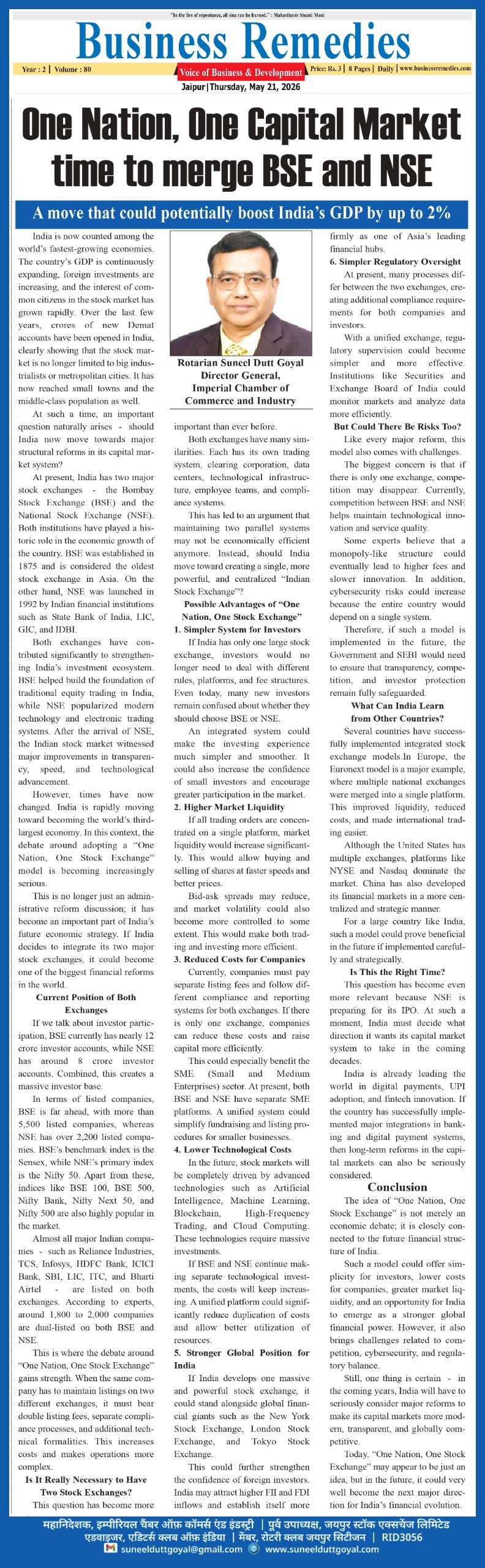

One Nation, One Capital Market ? Time to Merge BSE and NSE
A move that could potentially boost India?s GDP by up to 2%
India is now counted among the world?s fastest-growing economies. The country?s GDP is continuously expanding, foreign investments are increasing, and the interest of common citizens in the stock market has grown rapidly. Over the last few years, crores of new Demat accounts have been opened in India, clearly showing that the stock market is no longer limited to big industrialists or metropolitan cities. It has now reached small towns and the middle-class population as well.
At such a time, an important question naturally arises – should India now move towards major structural reforms in its capital market system?
At present, India has two major stock exchanges – the Bombay Stock Exchange (BSE) and the National Stock Exchange (NSE). Both institutions have played a historic role in the economic growth of the country. BSE was established in 1875 and is considered the oldest stock exchange in Asia. On the other hand, NSE was launched in 1992 by Indian financial institutions such as State Bank of India, LIC, GIC, and IDBI.
Both exchanges have contributed significantly to strengthening India?s investment ecosystem. BSE helped build the foundation of traditional equity trading in India, while NSE popularized modern technology and electronic trading systems. After the arrival of NSE, the Indian stock market witnessed major improvements in transparency, speed, and technological advancement.
However, times have now changed. India is rapidly moving toward becoming the world?s third-largest economy. In this context, the debate around adopting a ?One Nation, One Stock Exchange? model is becoming increasingly serious.
This is no longer just an administrative reform discussion; it has become an important part of India?s future economic strategy. If India decides to integrate its two major stock exchanges, it could become one of the biggest financial reforms in the world.
Current Position of Both Exchanges
If we talk about investor participation, BSE currently has nearly 12 crore investor accounts, while NSE has around 8 crore investor accounts. Combined, this creates a massive investor base.
In terms of listed companies, BSE is far ahead, with more than 5,500 listed companies, whereas NSE has over 2,200 listed companies. BSE?s benchmark index is the Sensex, while NSE?s primary index is the Nifty 50. Apart from these, indices like BSE 100, BSE 500, Nifty Bank, Nifty Next 50, and Nifty 500 are also highly popular in the market.
Almost all major Indian companies – such as Reliance Industries, TCS, Infosys, HDFC Bank, ICICI Bank, SBI, LIC, ITC, and Bharti Airtel – are listed on both exchanges. According to experts, around 1,800 to 2,000 companies are dual-listed on both BSE and NSE.
This is where the debate around ?One Nation, One Stock Exchange? gains strength. When the same company has to maintain listings on two different exchanges, it must bear double listing fees, separate compliance processes, and additional technical formalities. This increases costs and makes operations more complex.
Is It Really Necessary to Have Two Stock Exchanges?
This question has become more important than ever before.
Both exchanges have many similarities. Each has its own trading system, clearing corporation, data centers, technological infrastructure, employee teams, and compliance systems.
This has led to an argument that maintaining two parallel systems may not be economically efficient anymore. Instead, should India move toward creating a single, more powerful, and centralized ?Indian Stock Exchange??
Possible Advantages of ?One Nation, One Stock Exchange?
1. Simpler System for Investors
If India has only one large stock exchange, investors would no longer need to deal with different rules, platforms, and fee structures. Even today, many new investors remain confused about whether they should choose BSE or NSE.
An integrated system could make the investing experience much simpler and smoother. It could also increase the confidence of small investors and encourage greater participation in the market.
2. Higher Market Liquidity
If all trading orders are concentrated on a single platform, market liquidity would increase significantly. This would allow buying and selling of shares at faster speeds and better prices.
Bid-ask spreads may reduce, and market volatility could also become more controlled to some extent. This would make both trading and investing more efficient.
3. Reduced Costs for Companies
Currently, companies must pay separate listing fees and follow different compliance and reporting systems for both exchanges. If there is only one exchange, companies can reduce these costs and raise capital more efficiently.
This could especially benefit the SME (Small and Medium Enterprises) sector. At present, both BSE and NSE have separate SME platforms. A unified system could simplify fundraising and listing procedures for smaller businesses.
4. Lower Technological Costs
In the future, stock markets will be completely driven by advanced technologies such as Artificial Intelligence, Machine Learning, Blockchain, High-Frequency Trading, and Cloud Computing. These technologies require massive investments.
If BSE and NSE continue making separate technological investments, the costs will keep increasing. A unified platform could significantly reduce duplication of costs and allow better utilization of resources.
5. Stronger Global Position for India
If India develops one massive and powerful stock exchange, it could stand alongside global financial giants such as the New York Stock Exchange, London Stock Exchange, and Tokyo Stock Exchange.
This could further strengthen the confidence of foreign investors. India may attract higher FII and FDI inflows and establish itself more firmly as one of Asia?s leading financial hubs.
6. Simpler Regulatory Oversight
At present, many processes differ between the two exchanges, creating additional compliance requirements for both companies and investors.
With a unified exchange, regulatory supervision could become simpler and more effective. Institutions like Securities and Exchange Board of India could monitor markets and analyze data more efficiently.
But Could There Be Risks Too?
Like every major reform, this model also comes with challenges.
The biggest concern is that if there is only one exchange, competition may disappear. Currently, competition between BSE and NSE helps maintain technological innovation and service quality.
Some experts believe that a monopoly-like structure could eventually lead to higher fees and slower innovation. In addition, cybersecurity risks could increase because the entire country would depend on a single system.
Therefore, if such a model is implemented in the future, the Government and SEBI would need to ensure that transparency, competition, and investor protection remain fully safeguarded.
What Can India Learn from Other Countries?
Several countries have successfully implemented integrated stock exchange models.
In Europe, the Euronext model is a major example, where multiple national exchanges were merged into a single platform. This improved liquidity, reduced costs, and made international trading easier.
Although the United States has multiple exchanges, platforms like NYSE and Nasdaq dominate the market. China has also developed its financial markets in a more centralized and strategic manner.
For a large country like India, such a model could prove beneficial in the future if implemented carefully and strategically.
Is This the Right Time?
This question has become even more relevant because NSE is preparing for its IPO. At such a moment, India must decide what direction it wants its capital market system to take in the coming decades.
India is already leading the world in digital payments, UPI adoption, and fintech innovation. If the country has successfully implemented major integrations in banking and digital payment systems, then long-term reforms in the capital markets can also be seriously considered.
Conclusion
The idea of ?One Nation, One Stock Exchange? is not merely an economic debate; it is closely connected to the future financial structure of India.
Such a model could offer simplicity for investors, lower costs for companies, greater market liquidity, and an opportunity for India to emerge as a stronger global financial power. However, it also brings challenges related to competition, cybersecurity, and regulatory balance.
Still, one thing is certain – in the coming years, India will have to seriously consider major reforms to make its capital markets more modern, transparent, and globally competitive.
Today, ?One Nation, One Stock Exchange? may appear to be just an idea, but in the future, it could very well become the next major direction for India?s financial evolution.
Rotarian Suneel Dutt Goyal
Director General, Imperial Chamber of Commerce and Industry,
Adviser, Editor?s Club of India,
Ex. Vice President, Jaipur Stock Exchange Limited, Jaipur, Rajasthan,
Member, Rotary Club Jaipur Citizen, (RID3056)
suneelduttgoyal@gmail.com