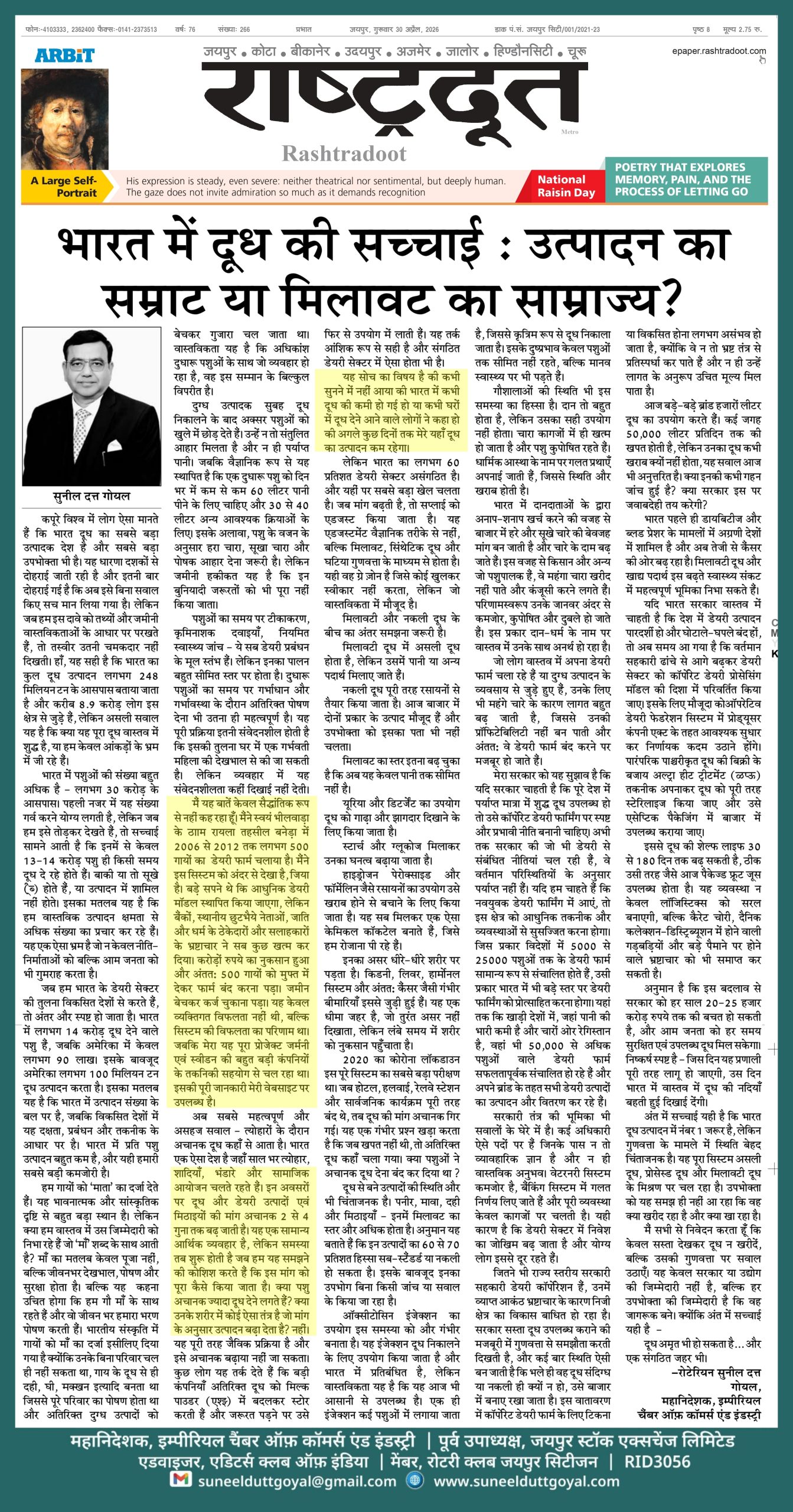

Across the world, it is widely believed that India is the largest producer and also the largest consumer of milk. This perception has been repeated for decades, and it has been repeated so often that people now accept it as unquestionable truth. However, when we examine this claim based on facts and ground realities, the picture does not appear as bright. Yes, it is true that India’s total milk production is said to be around 248 million tons, and nearly 89 million people are associated with this sector. But the real question is: is all this milk genuinely pure, or are we living in an illusion created by statistics?
India has a very large livestock population—around 300 million animals. At first glance, this number appears impressive and a matter of pride. But when we break it down, the reality emerges that only about 130–140 million animals are actually producing milk at any given time. The rest are either dry or not part of production. This means we are promoting inflated numbers beyond actual productive capacity. This creates a misleading perception not only for policymakers but also for the general public.
When we compare India’s dairy sector with developed countries, the gap becomes even clearer. India has about 140 million milk-producing animals, whereas the United States has only around 9 million. Despite this, the U.S. produces nearly 100 million tons of milk. This indicates that India’s production is driven by numbers, while developed countries rely on efficiency, management, and technology. Per-animal productivity in India is very low, and that is our biggest weakness.
We give cows the status of “mother”, which is a deeply emotional and cultural belief. But are we truly fulfilling the responsibility that comes with calling something “mother”? Being a mother is not just about worship—it involves lifelong care, nourishment, and protection. It would be more accurate to say that we live with cows, and they sustain us throughout our lives. In Indian culture, cows were given this status because families depended entirely on them—milk was used to make curd, ghee, butter, and other products, and surplus was sold for livelihood. However, the actual treatment of most dairy animals today is completely contrary to this respect.
After milking in the morning, producers often leave animals out in the open. They do not receive balanced nutrition or sufficient water. Scientifically, a dairy animal requires at least 60 liters of drinking water per day and an additional 30–40 liters for other bodily functions. Along with this, green fodder, dry fodder, and nutritional feed must be provided according to body weight. But the ground reality is that even these basic needs are not met.
Timely vaccination, deworming, and regular health check-ups are the pillars of dairy management, yet these are followed only at a very limited level. Proper breeding and additional nutrition during pregnancy are equally critical. This process is so sensitive that it can be compared to caring for a pregnant woman in a household. However, in practice, this sensitivity is largely absent.
I am not speaking theoretically. I personally ran a dairy farm of about 500 cows in Raayla village, Tehsil Banera, Bhilwara, from 2006 to 2012. I have seen and lived this system from the inside. I had big ambitions to establish a modern dairy model, but corruption involving banks, local small-time leaders, caste and religious influencers, and advisors destroyed everything. There was a loss of crores of rupees, and ultimately I had to shut down the farm and give away 500 cows for free. I had to sell land to repay debts. This was not just a personal failure but a failure of the system. This project was supported technically by major companies from Germany and Sweden, and full details are available on my website.
Now comes the most important and uncomfortable question—where does the extra milk come from during festivals? India is a country where festivals, weddings, community feasts, and social events occur throughout the year. During such occasions, the demand for milk and dairy products increases by 2 to 4 times. This is normal economic behavior. But the problem begins when we try to understand how this demand is fulfilled. Milk production is a biological process and cannot be suddenly increased. Some argue that large companies convert surplus milk into skimmed milk powder (SMP) and reuse it later. This is partially true and happens in the organized sector.
But it is worth thinking—have we ever heard of a shortage of milk in India? Has any milk supplier ever said that supply will be reduced for a few days?
The reality is that about 60% of India’s dairy sector is unorganized. This is where the real game happens. When demand rises, supply is “adjusted.” This adjustment is not scientific—it happens through adulteration, synthetic milk, and low-quality substitutes. This is the grey zone that no one openly acknowledges but undeniably exists.
It is important to understand the difference between adulterated and fake milk.
Adulterated milk contains real milk but is mixed with water or other substances.
Fake milk is entirely manufactured using chemicals.
Both types are widely present in the market, and consumers often cannot distinguish between them.
Adulteration is no longer limited to water.
Urea and detergents are used to make milk appear thicker and frothy.
Starch and glucose are added to increase density.
Hydrogen peroxide and formalin are used to prevent spoilage.
All of this creates a “chemical cocktail” that we consume daily.
These substances affect the body gradually—damaging kidneys, liver, hormonal systems, and even leading to diseases like cancer. It acts like slow poison, not showing immediate effects but causing long-term harm.
The COVID-19 lockdown of 2020 was the biggest test of this system. When hotels, sweet shops, railway stations, and public events were completely shut down, milk demand dropped drastically. This raises a serious question—where did the excess milk go? Did animals suddenly stop producing milk?
The situation of milk-based products is even more concerning. Paneer, mawa, curd, and sweets often have even higher levels of adulteration. Estimates suggest that 60–70% of these products may be substandard or fake. Yet they are consumed without question.
The use of oxytocin injections worsens the situation. Although banned in India, these injections are still easily available and used to extract milk artificially. A single injection is often used on multiple animals. Its harmful effects extend beyond animals and impact human health as well.
Cow shelters (gaushalas) are also part of the problem. Donations are abundant, but proper utilization is lacking. Fodder often exists only on paper, and animals remain malnourished. Misguided practices in the name of religious faith further worsen the situation.
Excessive spending by donors creates unnecessary demand for green and dry fodder, driving up prices. Farmers and livestock owners cannot afford expensive fodder and start cutting costs. As a result, animals become weak, malnourished, and underweight. Ironically, charity in the name of religion ends up harming them.
Those genuinely running dairy farms also suffer. High fodder costs increase production expenses, reducing profitability and forcing many to shut down operations.
My suggestion to the government is clear: if it wants to ensure sufficient availability of pure milk, it must develop a strong and clear policy for corporate dairy farming. Current policies are not adequate for present conditions.
To attract youth into dairy farming, the sector must be modernized with technology and proper systems. Just as farms with 5,000 to 25,000 animals operate efficiently in other countries, India must also promote large-scale dairy farming. Even in Gulf countries, where water is scarce, dairy farms with over 50,000 animals are successfully operating.
The role of government machinery is also questionable. Many officials lack practical knowledge and experience. The veterinary system is weak, banking decisions are flawed, and much of the system exists only on paper. This increases investment risk and discourages capable individuals.
State-level cooperative dairy corporations are heavily affected by corruption, which hinders private sector growth. In an attempt to provide cheap milk, the government often compromises on quality. At times, even questionable or fake milk continues to circulate in the market.
Large brands consume thousands of liters of milk daily—sometimes up to 50,000 liters—but why does their milk never spoil? Has there been any thorough investigation?
India is already among the leading countries in diabetes and blood pressure cases and is rapidly moving toward a cancer crisis. Adulterated milk and food products may play a significant role.
If the government truly wants transparency and wants to eliminate scams, it must shift toward a corporate dairy processing model. Instead of traditional pasteurized milk, Ultra Heat Treatment (UHT) should be adopted with aseptic packaging.
This can increase shelf life from 30 to 180 days, simplify logistics, and eliminate corruption and inefficiencies. It is estimated that this change could save the government ₹20,000–25,000 crore annually.
The conclusion is clear—once implemented, India will truly witness “rivers of milk.”
In the end, the truth is that while India is number one in milk production, the quality situation is deeply concerning. The system operates on a mix of real, processed, and adulterated milk, and consumers do not know what they are consuming.
I request everyone—do not buy milk just because it is cheap. Question its quality. This is the responsibility of every consumer.
Because the ultimate truth is:
Milk can be nectar… or it can be an organized poison.
Rotarian Suneel Dutt Goyal
Adviser, Editor’s Club of India,
Director General, Imperial Chamber of Commerce and Industry,
Ex. Vice President, Jaipur Stock Exchange Limited, Jaipur, Rajasthan,
Member, Rotary Club Jaipur Citizen, (RID3056)
suneelduttgoyal@gmail.com
भारत में दूध की सच्चाई: उत्पादन का सम्राट या मिलावट का साम्राज्य?
पूरे विश्व में लोग ऐसा मानते हैं कि भारत दूध का सबसे बड़ा उत्पादक देश है और सबसे बड़ा उपभोक्ता भी है। यह धारणा दशकों से दोहराई जाती रही है और इतनी बार दोहराई गई है कि अब इसे बिना सवाल किए सच मान लिया गया है। लेकिन जब हम इस दावे को तथ्यों और जमीनी वास्तविकताओं के आधार पर परखते हैं, तो तस्वीर उतनी चमकदार नहीं दिखती। हाँ, यह सही है कि भारत का कुल दूध उत्पादन लगभग 248 मिलियन टन के आसपास बताया जाता है और करीब 8.9 करोड़ लोग इस क्षेत्र से जुड़े हैं, लेकिन असली सवाल यह है कि क्या यह पूरा दूध वास्तव में शुद्ध है, या हम केवल आंकड़ों के भ्रम में जी रहे हैं।
भारत में पशुओं की संख्या बहुत अधिक है – लगभग 30 करोड़ के आसपास। पहली नजर में यह संख्या गर्व करने योग्य लगती है, लेकिन जब हम इसे तोड़कर देखते हैं, तो सच्चाई सामने आती है कि इनमें से केवल 13–14 करोड़ पशु ही किसी समय दूध दे रहे होते हैं। बाकी या तो सूखे (dry) होते हैं, या उत्पादन में शामिल नहीं होते। इसका मतलब यह है कि हम वास्तविक उत्पादन क्षमता से अधिक संख्या का प्रचार कर रहे हैं। यह एक ऐसा भ्रम है जो न केवल नीति-निर्माताओं को बल्कि आम जनता को भी गुमराह करता है।
जब हम भारत के डेयरी सेक्टर की तुलना विकसित देशों से करते हैं, तो अंतर और स्पष्ट हो जाता है। भारत में लगभग 14 करोड़ दूध देने वाले पशु हैं, जबकि अमेरिका में केवल लगभग 90 लाख। इसके बावजूद अमेरिका लगभग 100 मिलियन टन दूध उत्पादन करता है। इसका मतलब यह है कि भारत में उत्पादन संख्या के बल पर है, जबकि विकसित देशों में यह दक्षता, प्रबंधन और तकनीक के आधार पर है। भारत में प्रति पशु उत्पादन बहुत कम है, और यही हमारी सबसे बड़ी कमजोरी है।
हम गायों को ‘माता’ का दर्जा देते हैं। यह भावनात्मक और सांस्कृतिक दृष्टि से बहुत बड़ा स्थान है। लेकिन क्या हम वास्तव में उस जिम्मेदारी को निभा रहे हैं जो ‘माँ’ शब्द के साथ आती है? माँ का मतलब केवल पूजा नहीं, बल्कि जीवनभर देखभाल, पोषण और सुरक्षा होता है। बल्कि यह कहना उचित होगा कि हम गौ माँ के साथ रहते हैं और वो जीवन भर हमारा भरण पोषण करती हैं। भारतीय संस्कृति में गायों को माँ का दर्जा इसीलिए दिया गया है क्योंकि उनके बिना परिवार चल ही नहीं सकता था, गाय के दूध से ही दही, घी , मक्खन इत्यादि बनता था जिससे पूरे परिवार का पोषण होता था और अतिरिक्त दुग्ध उत्पादों को बेचकर गुजारा चल जाता था। वास्तविकता यह है कि अधिकांश दुधारू पशुओं के साथ जो व्यवहार हो रहा है, वह इस सम्मान के बिल्कुल विपरीत है।
दुग्ध उत्पादक सुबह दूध निकालने के बाद अक्सर पशुओं को खुले में छोड़ देते हैं। उन्हें न तो संतुलित आहार मिलता है और न ही पर्याप्त पानी। जबकि वैज्ञानिक रूप से यह स्थापित है कि एक दुधारू पशु को दिन भर में कम से कम 60 लीटर पानी पीने के लिए चाहिए और 30 से 40 लीटर अन्य आवश्यक क्रियाओं के लिए। इसके अलावा, पशु के वजन के अनुसार हरा चारा, सूखा चारा और पोषक आहार देना जरूरी है। लेकिन जमीनी हकीकत यह है कि इन बुनियादी जरूरतों को भी पूरा नहीं किया जाता।
पशुओं का समय पर टीकाकरण, कृमिनाशक दवाइयाँ, नियमित स्वास्थ्य जांच – ये सब डेयरी प्रबंधन के मूल स्तंभ हैं। लेकिन इनका पालन बहुत सीमित स्तर पर होता है। दुधारू पशुओं का समय पर गर्भाधान और गर्भावस्था के दौरान अतिरिक्त पोषण देना भी उतना ही महत्वपूर्ण है। यह पूरी प्रक्रिया इतनी संवेदनशील होती है कि इसकी तुलना घर में एक गर्भवती महिला की देखभाल से की जा सकती है। लेकिन व्यवहार में यह संवेदनशीलता कहीं दिखाई नहीं देती।
मैं यह बातें केवल सैद्धांतिक रूप से नहीं कह रहा हूँ। मैंने स्वयं भीलवाड़ा के ग्राम रायला तहसील बनेड़ा में 2006 से 2012 तक लगभग 500 गायों का डेयरी फार्म चलाया है। मैंने इस सिस्टम को अंदर से देखा है, जिया है। बड़े सपने थे कि आधुनिक डेयरी मॉडल स्थापित किया जाएगा, लेकिन बैंकों , स्थानीय छुटभैये नेताओं , जाति और धर्म के ठेकेदारों और सलाहकारों के भ्रष्टाचार ने सब कुछ खत्म कर दिया। करोड़ों रुपये का नुकसान हुआ और अंततः 500 गायों को मुफ्त में देकर फार्म बंद करना पड़ा। जमीन बेचकर कर्ज चुकाना पड़ा। यह केवल व्यक्तिगत विफलता नहीं थी, बल्कि सिस्टम की विफलता का परिणाम था। जबकि मेरा यह पूरा प्रोजेक्ट जर्मनी एवं स्वीडन की बहुत बड़ी कंपनियों के तकनिकी सहयोग से चल रहा था। इसकी पूरी जानकारी मेरी वेबसाइट पर उपलब्ध है।
अब सबसे महत्वपूर्ण और असहज सवाल – त्योहारों के दौरान अचानक दूध कहाँ से आता है। भारत एक ऐसा देश है जहाँ साल भर त्योहार, शादियाँ, भंडारे और सामाजिक आयोजन चलते रहते हैं। इन अवसरों पर दूध और डेयरी उत्पादों एवं मिठाइयों की मांग अचानक 2 से 4 गुना तक बढ़ जाती है। यह एक सामान्य आर्थिक व्यवहार है, लेकिन समस्या तब शुरू होती है जब हम यह समझने की कोशिश करते हैं कि इस मांग को पूरा कैसे किया जाता है। क्या पशु अचानक ज्यादा दूध देने लगते हैं? क्या उनके शरीर में कोई ऐसा तंत्र है जो मांग के अनुसार उत्पादन बढ़ा देता है? नहीं। यह पूरी तरह जैविक प्रक्रिया है और इसे अचानक बढ़ाया नहीं जा सकता। कुछ लोग यह तर्क देते हैं कि बड़ी कंपनियाँ अतिरिक्त दूध को मिल्क पाउडर (SMP) में बदलकर स्टोर करती हैं और जरूरत पड़ने पर उसे फिर से उपयोग में लाती हैं। यह तर्क आंशिक रूप से सही है और संगठित डेयरी सेक्टर में ऐसा होता भी है।
यह सोच का विषय है की कभी सुनने में नहीं आया की भारत में कभी दूध की कमी हो गई हो या कभी घरों में दूध देने आने वाले लोगों ने कहा हो की अगले कुछ दिनों तक मेरे यहाँ दूध का उत्पादन कम रहेगा।
लेकिन भारत का लगभग 60 प्रतिशत डेयरी सेक्टर असंगठित है। और यहीं पर सबसे बड़ा खेल चलता है। जब मांग बढ़ती है, तो सप्लाई को “एडजस्ट” किया जाता है। यह एडजस्टमेंट वैज्ञानिक तरीके से नहीं, बल्कि मिलावट, सिंथेटिक दूध और घटिया गुणवत्ता के माध्यम से होता है। यही वह ग्रे ज़ोन है जिसे कोई खुलकर स्वीकार नहीं करता, लेकिन जो वास्तविकता में मौजूद है।
मिलावटी और नकली दूध के बीच का अंतर समझना जरूरी है।
मिलावटी दूध में असली दूध होता है, लेकिन उसमें पानी या अन्य पदार्थ मिलाए जाते हैं।
नकली दूध पूरी तरह रसायनों से तैयार किया जाता है। आज बाजार में दोनों प्रकार के उत्पाद मौजूद हैं और उपभोक्ता को इसका पता भी नहीं चलता।
मिलावट का स्तर इतना बढ़ चुका है कि अब यह केवल पानी तक सीमित नहीं है।
यूरिया और डिटर्जेंट का उपयोग दूध को गाढ़ा और झागदार दिखाने के लिए किया जाता है।
स्टार्च और ग्लूकोज मिलाकर उनका घनत्व बढ़ाया जाता है।
हाइड्रोजन पेरोक्साइड और फॉर्मेलिन जैसे रसायनों का उपयोग उसे खराब होने से बचाने के लिए किया जाता है। यह सब मिलकर एक ऐसा “केमिकल कॉकटेल” बनाते हैं, जिसे हम रोजाना पी रहे हैं।
इनका असर धीरे-धीरे शरीर पर पड़ता है। किडनी, लिवर, हार्मोनल सिस्टम और अंततः कैंसर जैसी गंभीर बीमारियाँ इससे जुड़ी हुई हैं। यह एक धीमा जहर है, जो तुरंत असर नहीं दिखाता, लेकिन लंबे समय में शरीर को नुकसान पहुँचाता है।
2020 का कोरोना लॉकडाउन इस पूरे सिस्टम का सबसे बड़ा परीक्षण था। जब होटल, हलवाई, रेलवे स्टेशन और सार्वजनिक कार्यक्रम पूरी तरह बंद थे, तब दूध की मांग अचानक गिर गई। यह एक गंभीर प्रश्न खड़ा करता है कि जब खपत नहीं थी, तो अतिरिक्त दूध कहाँ चला गया। क्या पशुओं ने अचानक दूध देना बंद कर दिया था ?
दूध से बने उत्पादों की स्थिति और भी चिंताजनक है। पनीर, मावा, दही और मिठाइयाँ – इनमें मिलावट का स्तर और अधिक होता है। अनुमान यह बताते हैं कि इन उत्पादों का 60 से 70 प्रतिशत हिस्सा सब-स्टैंडर्ड या नकली हो सकता है। इसके बावजूद इनका उपभोग बिना किसी जांच या सवाल के किया जा रहा है।
ऑक्सीटोसिन इंजेक्शन का उपयोग इस समस्या को और गंभीर बनाता है। यह इंजेक्शन दूध निकालने के लिए उपयोग किया जाता है और भारत में प्रतिबंधित है, लेकिन वास्तविकता यह है कि यह आज भी आसानी से उपलब्ध है। एक ही इंजेक्शन कई पशुओं में लगाया जाता है, जिससे कृत्रिम रूप से दूध निकाला जाता है। इसके दुष्प्रभाव केवल पशुओं तक सीमित नहीं रहते, बल्कि मानव स्वास्थ्य पर भी पड़ते हैं।
गौशालाओं की स्थिति भी इस समस्या का हिस्सा है। दान तो बहुत होता है, लेकिन उसका सही उपयोग नहीं होता। चारा कागजों में ही खत्म हो जाता है और पशु कुपोषित रहते हैं। धार्मिक आस्था के नाम पर गलत प्रथाएँ अपनाई जाती हैं, जिससे स्थिति और खराब होती है।
भारत में दानदाताओं के द्वारा अनाप-शनाप खर्च करने की वजह से बाजार में हरे और सूखे चारे की बेवजह मांग बन जाती है और चारे के दाम बढ़ जाते हैं। इस वजह से किसान और अन्य जो पशुपालक हैं, वे महंगा चारा खरीद नहीं पाते और कंजूसी करने लगते हैं। परिणामस्वरूप उनके जानवर अंदर से कमजोर, कुपोषित और दुबले हो जाते हैं। इस प्रकार दान-धर्म के नाम पर वास्तव में उनके साथ अनर्थ हो रहा है।
जो लोग वास्तव में अपना डेयरी फार्म चला रहे हैं या दुग्ध उत्पादन के व्यवसाय से जुड़े हुए हैं, उनके लिए भी महंगे चारे के कारण लागत बहुत बढ़ जाती है, जिससे उनकी प्रॉफिटेबिलिटी नहीं बन पाती और अंततः वे डेयरी फार्म बंद करने पर मजबूर हो जाते हैं।
मेरा सरकार को यह सुझाव है कि यदि सरकार चाहती है कि पूरे देश में पर्याप्त मात्रा में शुद्ध दूध उपलब्ध हो तो उसे कॉर्पोरेट डेयरी फार्मिंग पर स्पष्ट और प्रभावी नीति बनानी चाहिए। अभी तक सरकार की जो भी डेयरी से संबंधित नीतियां चल रही हैं, वे वर्तमान परिस्थितियों के अनुसार पर्याप्त नहीं हैं।
यदि हम चाहते हैं कि नवयुवक डेयरी फार्मिंग में आएं, तो इस क्षेत्र को आधुनिक तकनीक और व्यवस्थाओं से सुसज्जित करना होगा। जिस प्रकार विदेशों में 5000 से 25000 पशुओं तक के डेयरी फार्म सामान्य रूप से संचालित होते हैं, उसी प्रकार भारत में भी बड़े स्तर पर डेयरी फार्मिंग को प्रोत्साहित करना होगा। यहां तक कि खाड़ी देशों में, जहां पानी की भारी कमी है और चारों ओर रेगिस्तान है, वहां भी 50,000 से अधिक पशुओं वाले डेयरी फार्म सफलतापूर्वक संचालित हो रहे हैं और अपने ब्रांड के तहत सभी डेयरी उत्पादों का उत्पादन और वितरण कर रहे हैं।
सरकारी तंत्र की भूमिका भी सवालों के घेरे में है। कई अधिकारी ऐसे पदों पर हैं जिनके पास न तो व्यावहारिक ज्ञान है और न ही वास्तविक अनुभव। वेटरनरी सिस्टम कमजोर है, बैंकिंग सिस्टम में गलत निर्णय लिए जाते हैं और पूरी व्यवस्था केवल कागजों पर चलती है। यही कारण है कि डेयरी सेक्टर में निवेश का जोखिम बढ़ जाता है और योग्य लोग इससे दूर रहते हैं।
जितने भी राज्य स्तरीय सरकारी सहकारी डेयरी कॉर्पोरेशन हैं, उनमें व्याप्त आकंठ भ्रष्टाचार के कारण निजी क्षेत्र का विकास बाधित हो रहा है। सरकार सस्ता दूध उपलब्ध कराने की मजबूरी में गुणवत्ता से समझौता करती दिखती है, और कई बार स्थिति ऐसी बन जाती है कि भले ही वह दूध संदिग्ध या नकली ही क्यों न हो, उसे बाजार में बनाए रखा जाता है। इस वातावरण में कॉर्पोरेट डेयरी फार्म के लिए टिकना या विकसित होना लगभग असंभव हो जाता है, क्योंकि वे न तो भ्रष्ट तंत्र से प्रतिस्पर्धा कर पाते हैं और न ही उन्हें लागत के अनुरूप उचित मूल्य मिल पाता है।
आज बड़े-बड़े ब्रांड हजारों लीटर दूध का उपयोग करते हैं। कई जगह 50,000 लीटर प्रतिदिन तक की खपत होती है, लेकिन उनका दूध कभी खराब क्यों नहीं होता, यह सवाल आज भी अनुत्तरित है। क्या इनकी कभी गहन जांच हुई है? क्या सरकार इस पर जवाबदेही तय करेगी?
भारत पहले ही डायबिटीज और ब्लड प्रेशर के मामलों में अग्रणी देशों में शामिल है और अब तेजी से कैंसर की ओर बढ़ रहा है। मिलावटी दूध और खाद्य पदार्थ इस बढ़ते स्वास्थ्य संकट में महत्वपूर्ण भूमिका निभा सकते हैं।
यदि भारत सरकार वास्तव में चाहती है कि देश में डेयरी उत्पादन पारदर्शी हो और घोटाले-घपले बंद हों, तो अब समय आ गया है कि वर्तमान सहकारी ढांचे से आगे बढ़कर डेयरी सेक्टर को कॉर्पोरेट डेयरी प्रोसेसिंग मॉडल की दिशा में परिवर्तित किया जाए। इसके लिए मौजूदा कोऑपरेटिव डेयरी फेडरेशन सिस्टम में प्रोड्यूसर कंपनी एक्ट के तहत आवश्यक सुधार कर निर्णायक कदम उठाने होंगे। पारंपरिक पाश्चरीकृत दूध की बिक्री के बजाय अल्ट्रा हीट ट्रीटमेंट (UHT) तकनीक अपनाकर दूध को पूरी तरह स्टेरिलाइज किया जाए और उसे एसेप्टिक पैकेजिंग में बाजार में उपलब्ध कराया जाए।
इससे दूध की शेल्फ लाइफ 30 से 180 दिन तक बढ़ सकती है, ठीक उसी तरह जैसे आज पैकेज्ड फ्रूट जूस उपलब्ध होता है। यह व्यवस्था न केवल लॉजिस्टिक्स को सरल बनाएगी, बल्कि कैरेट चोरी, दैनिक कलेक्शन-डिस्ट्रिब्यूशन में होने वाली गड़बड़ियों और बड़े पैमाने पर होने वाले भ्रष्टाचार को भी समाप्त कर सकती है।
अनुमान है कि इस बदलाव से सरकार को हर साल 20–25 हजार करोड़ रुपये तक की बचत हो सकती है, और आम जनता को हर समय सुरक्षित एवं उपलब्ध दूध मिल सकेगा। निष्कर्ष स्पष्ट है – जिस दिन यह प्रणाली पूरी तरह लागू हो जाएगी, उस दिन भारत में वास्तव में “दूध की नदियाँ” बहती हुई दिखाई देंगी।
अंत में सच्चाई यही है कि भारत दूध उत्पादन में नंबर 1 जरूर है, लेकिन गुणवत्ता के मामले में स्थिति बेहद चिंताजनक है। यह पूरा सिस्टम असली दूध, प्रोसेस्ड दूध और मिलावटी दूध के मिश्रण पर चल रहा है। उपभोक्ता को यह समझ ही नहीं आ रहा कि वह क्या खरीद रहा है और क्या खा रहा है।
मैं सभी से निवेदन करता हूँ कि केवल सस्ता देखकर दूध न खरीदें, बल्कि उसकी गुणवत्ता पर सवाल उठाएँ। यह केवल सरकार या उद्योग की जिम्मेदारी नहीं है, बल्कि हर उपभोक्ता की जिम्मेदारी है कि वह जागरूक बने। क्योंकि अंत में सच्चाई यही है –
दूध अमृत भी हो सकता है… और एक संगठित जहर भी।
रोटेरियन सुनील दत्त गोयल
महानिदेशक, इम्पीरियल चैंबर ऑफ़ कॉमर्स एंड इंडस्ट्री,
एडवाइजर, एडिटर्स क्लब ऑफ़ इंडिया,
पूर्व उपाध्यक्ष, जयपुर स्टॉक एक्सचेंज लिमिटेड, जयपुर, राजस्थान
मेंबर, रोटरी क्लब जयपुर सिटीजन, (RID3056)
suneelduttgoyal@gmail.com