
“I have seen homes break with my own eyes” – Law, Courts, and the Story of Men Who Die Silently
I have been closely witnessing a painful truth for the past few years. News appears in newspapers, videos play on social media, but the real story is written inside those homes where a husband, his elderly father, his mother, his sister – all are made to stand together in the dock of a courtroom.
I am not saying that crimes against women don’t happen. They do, and they are very serious. Dowry, domestic violence, mental harassment – these are all bitter truths of our society. But I want to ask – is every case the same? Is every 498A case truly a case of cruelty? And if not, what about those innocent people whose lives are ruined by just one complaint?
One FIR… and the entire family becomes criminals
Section 498A of the Indian Penal Code was added in 1983. The intention was to protect women from dowry and cruelty. But in practice, I have seen numerous cases where:
- Along with the husband, a 70-year-old mother is also an accused.
- A married sister living outside the city is also an accused.
- Even distant relatives are named.
As soon as an FIR is registered, the entire family is seen as criminals. Police interrogation, fear of arrest, passport seizure, impact on jobs – all of this begins.
The Supreme Court itself has said in many judgments that 498A should not be used for “routine arrest.” The court has expressed concern over its “misuse” and said that complaints are filed in an exaggerated manner. According to a recent report from the prosecution department, the conviction rate in cases related to women’s harassment has been consistently declining, which raises serious questions about the effective implementation of the law. Looking at the year-by-year data: until November 2021, the conviction rate was 22.21%; until October 2022, it was 22.33%; after that, it fell to 19.52% in October 2023, 19.21% in December 2024, and ultimately, until October 2025, it was just 16.44%. This means the conviction rate is decreasing over time, while a large number of accused are being acquitted by courts. This trend indicates that either there are serious flaws in investigation and evidence collection, or there is a suspicion of misuse of laws in some cases. According to NCRB data, the rate of charge sheet filing in 498A cases is very high, but the conviction rate remains around 14–16%.
This doesn’t mean that 84% of cases are false. But it does show that in a large number of cases, the accusations are ultimately not proven. But by that time, the accused family has already been dragged through the courts for 5–10 years.
When a woman commits suicide for any reason or files a harassment case, dozens of women’s organizations and NGOs in the village, city, or state start harassing the men from the other side. They start protesting in front of his home or office and begin blackmailing them in various ways. But have you ever heard of any men’s organization doing this for a man’s suicide? Take the case of the man from Singhanias in Bengaluru, who committed suicide by making a live recording on his Google Drive and writing a suicide note – was any action taken on that? Was he even mentioned in the newspapers again?
The horrific suicide statistics – which should shake us
According to the NCRB’s “Accidental Deaths & Suicides in India” report:
- Every year, about 70% of those who commit suicide are men.
- The number of suicides among married men is found to be significantly higher than among married women.
- Family problems and marital disputes are recorded as major causes.
- Data from 2022 and 2023 shows that out of over 1.6 lakh suicides, more than 1 lakh were men. A large number of these were married men.
I have seen families where the husband wrote in his suicide note: “I am innocent, but I cannot bear the case and the defamation.” I have seen elderly fathers who say: “We proved in court that our son was innocent, but he didn’t live to hear the verdict.” Every suicide is not just the death of one person. It is the social death of a family.
The Domestic Violence Act – but where can a man go?
“The Protection of Women from Domestic Violence Act, 2005” gave women many important rights like protection, the right to residence, maintenance, etc. But if a man is a victim of mental or physical violence, there is no parallel framework for him. In India, there is a National Commission for Women. There are State Women’s Commissions. But there is no “Men’s Commission” at the national level. I am not saying that a Women’s Commission is not needed. But shouldn’t there be balance in the justice system? Shouldn’t there be an institutional platform for men’s grievances?
Inequality in identity – social punishment first, court later
Under the law, the identity of a female victim is kept confidential – this is right and it should be. But I have seen that the male accused’s name, photo, profession, and full details are published in the media. Later, if he is acquitted, does the media publish his innocence with the same prominence? Once a reputation is tarnished, the stain remains for life.
I see another big, strange predicament in the law: whenever there is a case of women’s harassment, only a female judicial officer is appointed to hear it – whether it’s a lower court or a High Court. So, do the officers of the High Court believe that only a woman can deliver justice to a woman? Isn’t this a one-sided and one-way form of gender inequality? Don’t they trust their male judges or male judicial officers, believing that a man is useless from the start and it’s all his fault? That’s why a female judge is appointed, and she will give a harsh sentence. This is hypocrisy, this is gender inequality, and until this is ended, in the times to come, it will not just stop there; it will create bitterness in relationships.
Marital Rape and Marital Privacy
The ongoing debate on marital rape is extremely sensitive. On one hand, there is the question of a woman’s dignity and consent; on the other hand, there is the private sphere of marital relationships. I have read big judgments about marital rape these days. Will the court or the judiciary decide whether a relationship occurred between a husband and wife last night? If the wife was unwilling and the husband forced her into intercourse, what crime did he commit? She came into the marriage with the promise of staying together. And suppose sometimes the husband is unwilling and the wife forces herself, where will the wife go in that situation? And at that time, which sections of which law will be applied against whom?
There is a one-sided system in these laws. This form of law has started to create fear. These days, marriages are breaking very quickly, and I feel that these one-sided laws are contributing significantly to it somewhere. If this is declared a crime in the future, it will be necessary to ensure a clear definition, standards of proof, and a concrete process to prevent misuse. Otherwise, every marital dispute could turn into a potential criminal case.
The Divorce Process – a decade of life in court
In India, divorce cases can take 5–10 years. During this time:
- Maintenance orders
- Parallel cases like 498A, DV Act, 406 IPC
- Impact on passport, promotions, foreign opportunities
- The lives of both parties come to a standstill. But the man often gets trapped under the double burden of financial and legal pressure.
My suggestion to every family on the groom’s side is that whether the bride or her family has a government job, a private job, or is from a business family, when the bride’s side files such a lawsuit, they show having given an immense amount of dowry, while their financial status and income tax returns/documents do not in any way prove this. My suggestion to the government, to the police, and to all the groom’s families is that whenever any such case is filed, you must definitely complain to the Income Tax Department, the Vigilance Department, their concerned government department, and the Anti-Corruption Department, so that it can be found out where they brought so much wealth from. After all, they must prove their claim that they even had sources of income for that amount.
Live-in Relationships: Culture vs. Constitutional Freedom
I say this openly – the traditional structure of Indian society has been based on the institution of marriage. Here, a family is not just a private contract between two individuals, but a social and cultural unit. Our traditional values have never accepted live-in relationships. In our culture, marriage is not just consent; it’s a sacrament. But over time, the judiciary has given primacy to individual freedom. The Supreme Court of India has made it clear in several judgments that consenting adults living together is not a crime and it is part of the right to life and liberty under Article 21 of the Constitution. Former Chief Justice D. Y. Chandrachud, emphasizing individual freedom, had stated that courts cannot interfere in the choices of adults based on “social morality.” The court has also recognized that if a relationship is “in the nature of marriage,” a woman can get protection under the Domestic Violence Act.
Here, my question is not about the intent of the judiciary, but about the social impact. Is society ready for this change? Are we weakening the institution of marriage? Will every failed live-in relationship eventually turn into a criminal case? The Constitution grants personal liberty, but it does not authorize the destruction of the country and social fabric.
Live-in Relationships and Criminal Cases
The Supreme Court has made it clear that consenting adults living together is not a crime. But at the ground level, it has been observed that when a relationship breaks down, accusations are made under sections like 376 (false promise), 417 (cheating), and 498A. I repeat again – strict action should be taken in cases of genuine deceit and exploitation. But if there was a consensual relationship between two adults, turning every failed love story into a criminal case is not an extension of justice, it’s its distortion.
“False Promise of Marriage” and Rape Cases
In recent years, there has been an increase in rape cases under Section 376 of the IPC based on a “false promise of marriage.” The Supreme Court and various High Courts have clarified in many judgments that:
- If the intention to marry was deceitful from the very beginning, it can be a crime.
- But if there was a consensual relationship between two adults and for some reason marriage did not take place later, not every case automatically becomes rape.
I have seen cases where the relationship lasted for years, families were aware, and then the relationship broke down – and later, serious criminal charges were filed. By the time the court decides whether the case was genuine or not, the accused has already suffered social death.
What can we learn from developed countries?
In countries like America, Britain, and Australia, domestic violence laws are often gender-neutral.
- Domestic violence laws are gender-neutral.
- Clear punishment for false complaints.
- Investigation before arrest.
- Timelines for divorce cases.
- Mental health support systems.
India should also consider reforms:
- Gender-neutral laws.
- Mandatory preliminary inquiry before FIR.
- Swift punishment for false cases.
- Establishment of a Men’s Commission.
- Equality in identity confidentiality.
- Time-bound hearings for divorce and family matters.
My Personal Appeal
Today, the media, multinational companies, a large segment of society, and educational institutions have filled women with such extreme overconfidence that they have started making decisions based on what others say, instead of their own conscience, and “men have been declared villains in all these systems.” This entire segment has forgotten that God, whether feminine or masculine, crafted both together, with their own distinct arts and expertise. Until these two expertise’s come together, a strong society cannot be built. If there is an imbalance between the two wheels – which, in my opinion, has already started – then its negative consequences are appearing, and in the coming 10–15 years, the percentage of these consequences will increase dramatically. The fragmentation of Indian families will happen very rapidly. For this, I hold women more responsible than men, because they have started considering themselves super powerful, super talented.
I apologize to women for writing this, but my intention and purpose are not wrong. I am concerned about the way families are disintegrating. Because of this overconfidence, they are losing their families. There is no room for compromise left within them. In my lifetime, I have seen such large families where there were senior administrative officers, judicial officers, or politicians. When such incidents happen during their service, they themselves cannot take any action due to fear. And the man, or the entire family, is forced to endure the tyranny of the daughter-in-law or wife who has come into their home, mercilessly.
I know that in Jaipur, around 200 divorce cases are filed daily in the Jaipur district. This in itself is proof of how lives are being ruined. Both classes are responsible for this – one because of excessive tolerance and the other because of excessive arrogance. Today, many innocent men stand in courts, their elderly parents run around police stations, children suffer psychological trauma. And some men – silently, without any noise – are taking their own lives. Will we wake up only when the statistics increase further? Or will we take steps towards reviewing, balancing, and reforming the laws now? Justice cannot be one-sided. The law should provide protection, not fear. And if balance is disrupted anywhere, then correcting it is the maturity of a democracy.
Rotarian Suneel Dutt Goyal
Adviser, Editor’s Club of India,
Director General, Imperial Chamber of Commerce and Industry,
Ex. Vice President, Jaipur Stock Exchange Limited, Jaipur, Rajasthan,
Member, Rotary Club Jaipur Citizen, (RID3056)
suneelduttgoyal@gmail.com
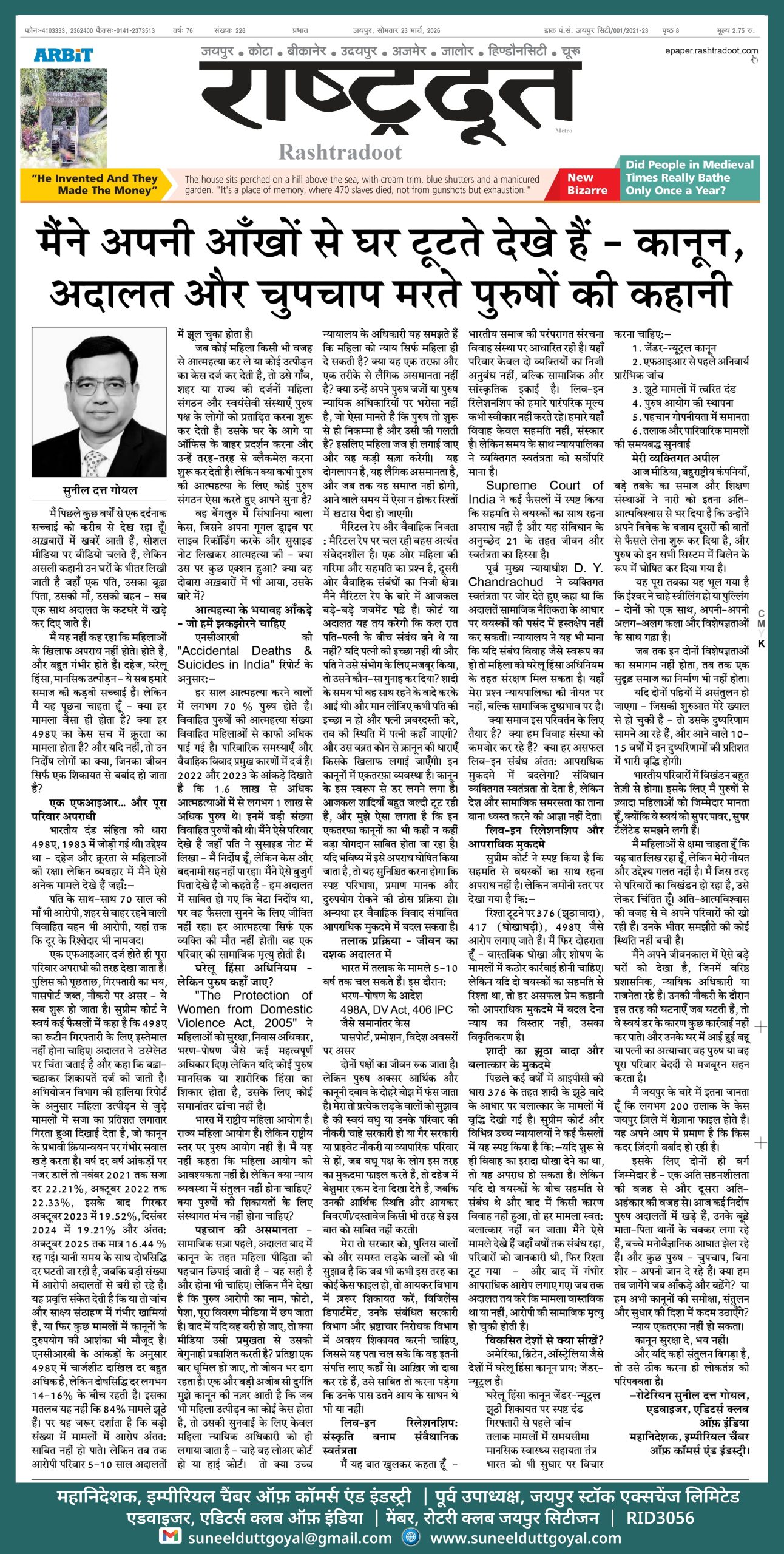
“मैंने अपनी आँखों से घर टूटते देखे हैं” – कानून, अदालत और चुपचाप मरते पुरुषों की कहानी
मैं पिछले कुछ वर्षों से एक दर्दनाक सच्चाई को करीब से देख रहा हूँ। अख़बारों में खबरें आती हैं, सोशल मीडिया पर वीडियो चलते हैं, लेकिन असली कहानी उन घरों के भीतर लिखी जाती है जहाँ एक पति, उसका बूढ़ा पिता, उसकी माँ, उसकी बहन – सब एक साथ अदालत के कटघरे में खड़े कर दिए जाते हैं।
मैं यह नहीं कह रहा कि महिलाओं के खिलाफ अपराध नहीं होते। होते हैं, और बहुत गंभीर होते हैं। दहेज, घरेलू हिंसा, मानसिक उत्पीड़न – ये सब हमारे समाज की कड़वी सच्चाई हैं। लेकिन मैं यह पूछना चाहता हूँ – क्या हर मामला वैसा ही होता है? क्या हर 498A का केस सच में क्रूरता का मामला होता है? और यदि नहीं, तो उन निर्दोष लोगों का क्या, जिनका जीवन सिर्फ एक शिकायत से बर्बाद हो जाता है?
एक FIR… और पूरा परिवार अपराधी
भारतीय दंड संहिता की धारा 498A, 1983 में जोड़ी गई थी। उद्देश्य था – दहेज और क्रूरता से महिलाओं की रक्षा। लेकिन व्यवहार में मैंने ऐसे अनेक मामले देखे हैं जहाँ:
- पति के साथ-साथ 70 साल की माँ भी आरोपी
- शहर से बाहर रहने वाली विवाहित बहन भी आरोपी
- यहां तक कि दूर के रिश्तेदार भी नामजद
एक FIR दर्ज होते ही पूरा परिवार अपराधी की तरह देखा जाता है। पुलिस की पूछताछ, गिरफ्तारी का भय, पासपोर्ट जब्त, नौकरी पर असर – ये सब शुरू हो जाता है।
सुप्रीम कोर्ट ने स्वयं कई फैसलों में कहा है कि 498A का “रूटीन गिरफ्तारी” के लिए इस्तेमाल नहीं होना चाहिए। अदालत ने “misuse” पर चिंता जताई है और कहा कि बढ़ा-चढ़ाकर शिकायतें दर्ज की जाती हैं। अभियोजन विभाग की हालिया रिपोर्ट के अनुसार महिला उत्पीड़न से जुड़े मामलों में सजा का प्रतिशत लगातार गिरता हुआ दिखाई देता है, जो कानून के प्रभावी क्रियान्वयन पर गंभीर सवाल खड़े करता है। वर्ष दर वर्ष आंकड़ों पर नजर डालें तो नवंबर 2021 तक सजा दर 22.21%, अक्टूबर 2022 तक 22.33%, इसके बाद गिरकर अक्टूबर 2023 में 19.52%, दिसंबर 2024 में 19.21% और अंततः अक्टूबर 2025 तक मात्र 16.44% रह गई। यानी समय के साथ दोषसिद्धि दर घटती जा रही है, जबकि बड़ी संख्या में आरोपी अदालतों से बरी हो रहे हैं। यह प्रवृत्ति संकेत देती है कि या तो जांच और साक्ष्य संग्रहण में गंभीर खामियां हैं, या फिर कुछ मामलों में कानूनों के दुरुपयोग की आशंका भी मौजूद है। NCRB के आंकड़ों के अनुसार 498A में चार्जशीट दाखिल दर बहुत अधिक है, लेकिन दोषसिद्धि दर लगभग 14–16% के बीच रहती है।
इसका मतलब यह नहीं कि 84% मामले झूठे हैं। पर यह जरूर दर्शाता है कि बड़ी संख्या में मामलों में आरोप अंततः साबित नहीं हो पाते। लेकिन तब तक आरोपी परिवार 5–10 साल अदालतों में झूल चुका होता है।
जब कोई महिला किसी भी वजह से आत्महत्या कर ले या कोई उत्पीड़न का केस दर्ज कर देती है, तो उसे गाँव, शहर या राज्य की दर्जनों महिला संगठन और स्वयंसेवी संस्थाएँ पुरुष पक्ष के लोगों को प्रताड़ित करना शुरू कर देती हैं। उसके घर के आगे या ऑफिस के बाहर प्रदर्शन करना और उन्हें तरह-तरह से ब्लैकमेल करना शुरू कर देती हैं।
लेकिन क्या कभी पुरुष की आत्महत्या के लिए कोई पुरुष संगठन ऐसा करते हुए आपने सुना है?
वह बेंगलुरु में सिंघानिया वाला केस, जिसने अपना गूगल ड्राइव पर लाइव रिकॉर्डिंग करके और सुसाइड नोट लिखकर आत्महत्या की – क्या उस पर कुछ एक्शन हुआ? क्या वह दोबारा अख़बारों में भी आया, उसके बारे में?
आत्महत्या के भयावह आँकड़े – जो हमें झकझोरने चाहिए
NCRB की “Accidental Deaths & Suicides in India” रिपोर्ट के अनुसार:
- हर साल आत्महत्या करने वालों में लगभग 70% पुरुष होते हैं।
- विवाहित पुरुषों की आत्महत्या संख्या विवाहित महिलाओं से काफी अधिक पाई गई है।
- पारिवारिक समस्याएँ और वैवाहिक विवाद प्रमुख कारणों में दर्ज हैं।
2022 और 2023 के आंकड़े दिखाते हैं कि 1.6 लाख से अधिक आत्महत्याओं में से लगभग 1 लाख से अधिक पुरुष थे। इनमें बड़ी संख्या विवाहित पुरुषों की थी।
मैंने ऐसे परिवार देखे हैं जहाँ पति ने सुसाइड नोट में लिखा – “मैं निर्दोष हूँ, लेकिन केस और बदनामी सह नहीं पा रहा।”
मैंने ऐसे बुजुर्ग पिता देखे हैं जो कहते हैं – “हम अदालत में साबित हो गए कि बेटा निर्दोष था, पर वह फैसला सुनने के लिए जीवित नहीं रहा।”
हर आत्महत्या सिर्फ एक व्यक्ति की मौत नहीं होती। वह एक परिवार की सामाजिक मृत्यु होती है।
घरेलू हिंसा अधिनियम – लेकिन पुरुष कहाँ जाए?
“The Protection of Women from Domestic Violence Act, 2005” ने महिलाओं को सुरक्षा, निवास अधिकार, भरण-पोषण जैसे कई महत्वपूर्ण अधिकार दिए।
लेकिन यदि कोई पुरुष मानसिक या शारीरिक हिंसा का शिकार होता है, उसके लिए कोई समानांतर ढांचा नहीं है।
भारत में राष्ट्रीय महिला आयोग है। राज्य महिला आयोग हैं।
लेकिन राष्ट्रीय स्तर पर “पुरुष आयोग” नहीं है।
मैं यह नहीं कहता कि महिला आयोग की आवश्यकता नहीं है। लेकिन क्या न्याय व्यवस्था में संतुलन नहीं होना चाहिए? क्या पुरुषों की शिकायतों के लिए संस्थागत मंच नहीं होना चाहिए?
पहचान की असमानता – सामाजिक सज़ा पहले, अदालत बाद में
कानून के तहत महिला पीड़िता की पहचान छिपाई जाती है – यह सही है और होना भी चाहिए।
लेकिन मैंने देखा है कि पुरुष आरोपी का नाम, फोटो, पेशा, पूरा विवरण मीडिया में छप जाता है। बाद में यदि वह बरी हो जाए, तो क्या मीडिया उसी प्रमुखता से उसकी बेगुनाही प्रकाशित करती है?
प्रतिष्ठा एक बार धूमिल हो जाए, तो जीवन भर दाग रहता है।
एक और बड़ी अजीब सी दुर्गति मुझे कानून की नज़र आती है कि जब भी महिला उत्पीड़न का कोई केस होता है, तो उसकी सुनवाई के लिए केवल महिला न्यायिक अधिकारी को ही लगाया जाता है – चाहे वह लोअर कोर्ट हो या हाई कोर्ट।
तो क्या उच्च न्यायालय के अधिकारी यह समझते हैं कि महिला को न्याय सिर्फ महिला ही दे सकती है? क्या यह एक तरफ़ा और एक तरीके से लैंगिक असमानता नहीं है?
क्या उन्हें अपने पुरुष जजों या पुरुष न्यायिक अधिकारियों पर भरोसा नहीं है, जो ऐसा मानते हैं कि पुरुष तो शुरू से ही निकम्मा है और उसी की गलती है? इसलिए महिला जज ही लगाई जाए और वह कड़ी सज़ा करेगी।
यह दोगलापन है, यह लैंगिक असमानता है, और जब तक यह समाप्त नहीं होगी, आने वाले समय में ऐसा न होकर रिश्तों में खटास पैदा हो जाएगी।
मैरिटल रेप और वैवाहिक निजता
मैरिटल रेप पर चल रही बहस अत्यंत संवेदनशील है। एक ओर महिला की गरिमा और सहमति का प्रश्न है, दूसरी ओर वैवाहिक संबंधों का निजी क्षेत्र।
मैंने मैरिटल रेप के बारे में आजकल बड़े-बड़े जजमेंट पढ़े हैं। कोर्ट या अदालत यह तय करेगी कि कल रात पति-पत्नी के बीच संबंध बने थे या नहीं?
यदि पत्नी की इच्छा नहीं थी और पति ने उसे संभोग के लिए मजबूर किया, तो उसने कौन-सा गुनाह कर दिया?
शादी के समय भी वह साथ रहने के वादे करके आई थी। और मान लीजिए कभी पति की इच्छा न हो और पत्नी ज़बरदस्ती करे, तब की स्थिति में पत्नी कहाँ जाएगी? और उस वक़्त कोन से क़ानून की धाराएँ किसके खिलाफ लगाई जाएँगी|
इन कानूनों में एकतरफ़ा व्यवस्था है। कानून के इस स्वरूप से डर लगने लगा है। आजकल शादियाँ बहुत जल्दी टूट रही हैं, और मुझे ऐसा लगता है कि इन एकतरफा कानूनों का भी कहीं न कहीं बड़ा योगदान साबित होता जा रहा है।
यदि भविष्य में इसे अपराध घोषित किया जाता है, तो यह सुनिश्चित करना होगा कि स्पष्ट परिभाषा, प्रमाण मानक और दुरुपयोग रोकने की ठोस प्रक्रिया हो। अन्यथा हर वैवाहिक विवाद संभावित आपराधिक मुकदमे में बदल सकता है।
तलाक प्रक्रिया – जीवन का दशक अदालत में
भारत में तलाक के मामले 5–10 वर्ष तक चल सकते हैं। इस दौरान:
- भरण-पोषण के आदेश
- 498A, DV Act, 406 IPC जैसे समानांतर केस
- पासपोर्ट, प्रमोशन, विदेश अवसरों पर असर
दोनों पक्षों का जीवन रुक जाता है। लेकिन पुरुष अक्सर आर्थिक और कानूनी दबाव के दोहरे बोझ में फंस जाता है।
मेरा तो प्रत्येक लड़के वालों को सुझाव है की स्वयं वधु या उनके परिवार की नौकरी चाहे सरकारी हो या गैर सरकारी या प्राइवेट नौकरी या व्यापारिक परिवार से हों, जब वधू पक्ष के लोग इस तरह का मुकदमा फाइल करते हैं, तो दहेज में बेशुमार रकम देना दिखा देते हैं, जबकि उनकी आर्थिक स्थिति और आयकर विवरणी/दस्तावेज किसी भी तरह से इस बात को साबित नहीं करती।
मेरा तो सरकार को, पुलिस वालों को और समस्त लड़के वालों को भी सुझाव है कि जब भी कभी इस तरह का कोई केस फाइल हो, तो आयकर विभाग में ज़रूर शिकायत करें, विजिलेंस डिपार्टमेंट, उनके संबंधित सरकारी विभाग और भ्रष्टाचार निरोधक विभाग में अवश्य शिकायत करनी चाहिए, जिससे यह पता चल सके कि वह इतनी संपत्ति लाए कहाँ से। आख़िर जो दावा कर रहे हैं, उसे साबित तो करना पड़ेगा कि उनके पास उतने आय के साधन थे भी या नहीं।
लिव-इन रिलेशनशिप: संस्कृति बनाम संवैधानिक स्वतंत्रता
मैं यह बात खुलकर कहता हूँ – भारतीय समाज की परंपरागत संरचना विवाह संस्था पर आधारित रही है। यहाँ परिवार केवल दो व्यक्तियों का निजी अनुबंध नहीं, बल्कि सामाजिक और सांस्कृतिक इकाई है।
लिव-इन रिलेशनशिप को हमारे पारंपरिक मूल्य कभी स्वीकार नहीं करते रहे। हमारे यहाँ विवाह केवल सहमति नहीं, संस्कार है। लेकिन समय के साथ न्यायपालिका ने व्यक्तिगत स्वतंत्रता को सर्वोपरि माना है।
Supreme Court of India ने कई फैसलों में स्पष्ट किया कि सहमति से वयस्कों का साथ रहना अपराध नहीं है और यह संविधान के अनुच्छेद 21 के तहत जीवन और स्वतंत्रता का हिस्सा है।
पूर्व मुख्य न्यायाधीश D. Y. Chandrachud ने व्यक्तिगत स्वतंत्रता पर जोर देते हुए कहा था कि अदालतें “सामाजिक नैतिकता” के आधार पर वयस्कों की पसंद में हस्तक्षेप नहीं कर सकतीं।
न्यायालय ने यह भी माना कि यदि संबंध “विवाह जैसे स्वरूप” का हो तो महिला को घरेलू हिंसा अधिनियम के तहत संरक्षण मिल सकता है।
यहाँ मेरा प्रश्न न्यायपालिका की नीयत पर नहीं, बल्कि सामाजिक दुष्प्रभाव पर है।
क्या समाज इस परिवर्तन के लिए तैयार है?
क्या हम विवाह संस्था को कमजोर कर रहे हैं?
क्या हर असफल लिव-इन संबंध अंततः आपराधिक मुकदमे में बदलेगा?
संविधान व्यक्तिगत स्वतंत्रता तो देता है, लेकिन देश और सामाजिक समरसता का ताना बाना ध्वस्त करने की आज्ञा नहीं देता।
लिव-इन रिलेशनशिप और आपराधिक मुकदमे
सुप्रीम कोर्ट ने स्पष्ट किया है कि सहमति से वयस्कों का साथ रहना अपराध नहीं है।
लेकिन जमीनी स्तर पर देखा गया है कि:
- रिश्ता टूटने पर 376 (झूठा वादा),
- 417 (धोखाधड़ी),
- 498A जैसे आरोप लगाए जाते हैं।
मैं फिर दोहराता हूँ – वास्तविक धोखा और शोषण के मामलों में कठोर कार्रवाई होनी चाहिए। लेकिन यदि दो वयस्कों का सहमति से रिश्ता था, तो हर असफल प्रेम कहानी को आपराधिक मुकदमे में बदल देना न्याय का विस्तार नहीं, उसका विकृतिकरण है।
“शादी का झूठा वादा” और बलात्कार के मुकदमे
पिछले कई वर्षों में IPC की धारा 376 के तहत “शादी के झूठे वादे” के आधार पर बलात्कार के मामलों में वृद्धि देखी गई है।
सुप्रीम कोर्ट और विभिन्न उच्च न्यायालयों ने कई फैसलों में यह स्पष्ट किया है कि:
- यदि शुरू से ही विवाह का इरादा धोखा देने का था, तो यह अपराध हो सकता है।
- लेकिन यदि दो वयस्कों के बीच सहमति से संबंध थे और बाद में किसी कारण विवाह नहीं हुआ, तो हर मामला स्वतः बलात्कार नहीं बन जाता।
मैंने ऐसे मामले देखे हैं जहाँ वर्षों तक संबंध रहा, परिवारों को जानकारी थी, फिर रिश्ता टूट गया – और बाद में गंभीर आपराधिक आरोप लगाए गए।
जब तक अदालत तय करे कि मामला वास्तविक था या नहीं, आरोपी की सामाजिक मृत्यु हो चुकी होती है।
विकसित देशों से क्या सीखें?
अमेरिका, ब्रिटेन, ऑस्ट्रेलिया जैसे देशों में घरेलू हिंसा कानून प्रायः जेंडर-न्यूट्रल हैं।
- घरेलू हिंसा कानून जेंडर-न्यूट्रल
- झूठी शिकायत पर स्पष्ट दंड
- गिरफ्तारी से पहले जांच
- तलाक मामलों में समयसीमा
- मानसिक स्वास्थ्य सहायता तंत्र
भारत को भी सुधार पर विचार करना चाहिए:
- जेंडर-न्यूट्रल कानून
- FIR से पहले अनिवार्य प्रारंभिक जांच
- झूठे मामलों में त्वरित दंड
- पुरुष आयोग की स्थापना
- पहचान गोपनीयता में समानता
- तलाक और पारिवारिक मामलों की समयबद्ध सुनवाई
मेरी व्यक्तिगत अपील
आज मीडिया, बहुराष्ट्रीय कंपनियाँ, बड़े तबके का समाज और शिक्षण संस्थाओं ने नारी को इतना अति-आत्मविश्वास से भर दिया है कि उन्होंने अपने विवेक के बजाय दूसरों की बातों से फैसले लेना शुरू कर दिया है, और “पुरुष को इन सभी सिस्टम में विलेन के रूप में घोषित कर दिया गया है।”
यह पूरा तबका यह भूल गया है कि ईश्वर ने चाहे स्त्रीलिंग हो या पुल्लिंग – दोनों को एक साथ, अपनी-अपनी अलग-अलग कला और विशेषज्ञताओं के साथ गढ़ा है।
जब तक इन दोनों विशेषज्ञताओं का समागम नहीं होता, तब तक एक सुदृढ़ समाज का निर्माण भी नहीं होता।
यदि दोनों पहियों में असंतुलन हो जाएगा – जिसकी शुरुआत मेरे ख्याल से हो चुकी है – तो उसके दुष्परिणाम सामने आ रहे हैं, और आने वाले 10–15 वर्षों में इन दुष्परिणामों की प्रतिशत में भारी वृद्धि होगी।
भारतीय परिवारों में विखंडन बहुत तेज़ी से होगा। इसके लिए मैं पुरुषों से ज़्यादा महिलाओं को जिम्मेदार मानता हूँ, क्योंकि वे स्वयं को सुपर पावर, सुपर टैलेंटेड समझने लगी हैं।
मैं महिलाओं से क्षमा चाहता हूँ कि यह बात लिख रहा हूँ, लेकिन मेरी नीयत और उद्देश्य गलत नहीं है। मैं जिस तरह से परिवारों का विखंडन हो रहा है, उसे लेकर चिंतित हूँ। अति-आत्मविश्वास की वजह से वे अपने परिवारों को खो रही हैं। उनके भीतर समझौते की कोई स्थिति नहीं बची है।
मैंने अपने जीवनकाल में ऐसे बड़े घरों को देखा है, जिनमें वरिष्ठ प्रशासनिक, न्यायिक अधिकारी या राजनेता रहे हैं। उनकी नौकरी के दौरान इस तरह की घटनाएँ जब घटती हैं, तो वे स्वयं डर के कारण कुछ कार्रवाई नहीं कर पाते। और उनके घर में आई हुई बहू या पत्नी का अत्याचार वह पुरुष या वह पूरा परिवार बेदर्दी से मजबूरन सहन करता है।
मैं जयपुर के बारे में इतना जानता हूँ कि लगभग 200 तलाक के केस जयपुर ज़िले में रोज़ाना फाइल होते हैं। यह अपने आप में प्रमाण है कि किस कदर ज़िंदगी बर्बाद हो रही है।
इसके लिए दोनों ही वर्ग जिम्मेदार हैं – एक अति सहनशीलता की वजह से और दूसरा अति-अहंकार की वजह से।
आज कई निर्दोष पुरुष अदालतों में खड़े हैं, उनके बूढ़े माता-पिता थानों के चक्कर लगा रहे हैं, बच्चे मनोवैज्ञानिक आघात झेल रहे हैं।
और कुछ पुरुष – चुपचाप, बिना शोर – अपनी जान दे रहे हैं।
क्या हम तब जागेंगे जब आँकड़े और बढ़ेंगे?
या हम अभी कानूनों की समीक्षा, संतुलन और सुधार की दिशा में कदम उठाएँगे?
न्याय एकतरफा नहीं हो सकता।
कानून सुरक्षा दे, भय नहीं।
और यदि कहीं संतुलन बिगड़ा है, तो उसे ठीक करना ही लोकतंत्र की परिपक्वता है।
रोटेरियन सुनील दत्त गोयल
एडवाइजर, एडिटर्स क्लब ऑफ़ इंडिया
महानिदेशक, इम्पीरियल चैंबर ऑफ़ कॉमर्स एंड इंडस्ट्री,
पूर्व उपाध्यक्ष, जयपुर स्टॉक एक्सचेंज लिमिटेड, जयपुर, राजस्थान
मेंबर, रोटरी क्लब जयपुर सिटीजन, (RID3056)
suneelduttgoyal@gmail.com